

Eight months into Malaysia’s first national medical tourism year, the arrivals and revenue numbers are up, one hospital is doing a third of the work, and the industry cannot agree on its own 2030 target. Here is where MYMT 2026 actually stands.
Quick answer
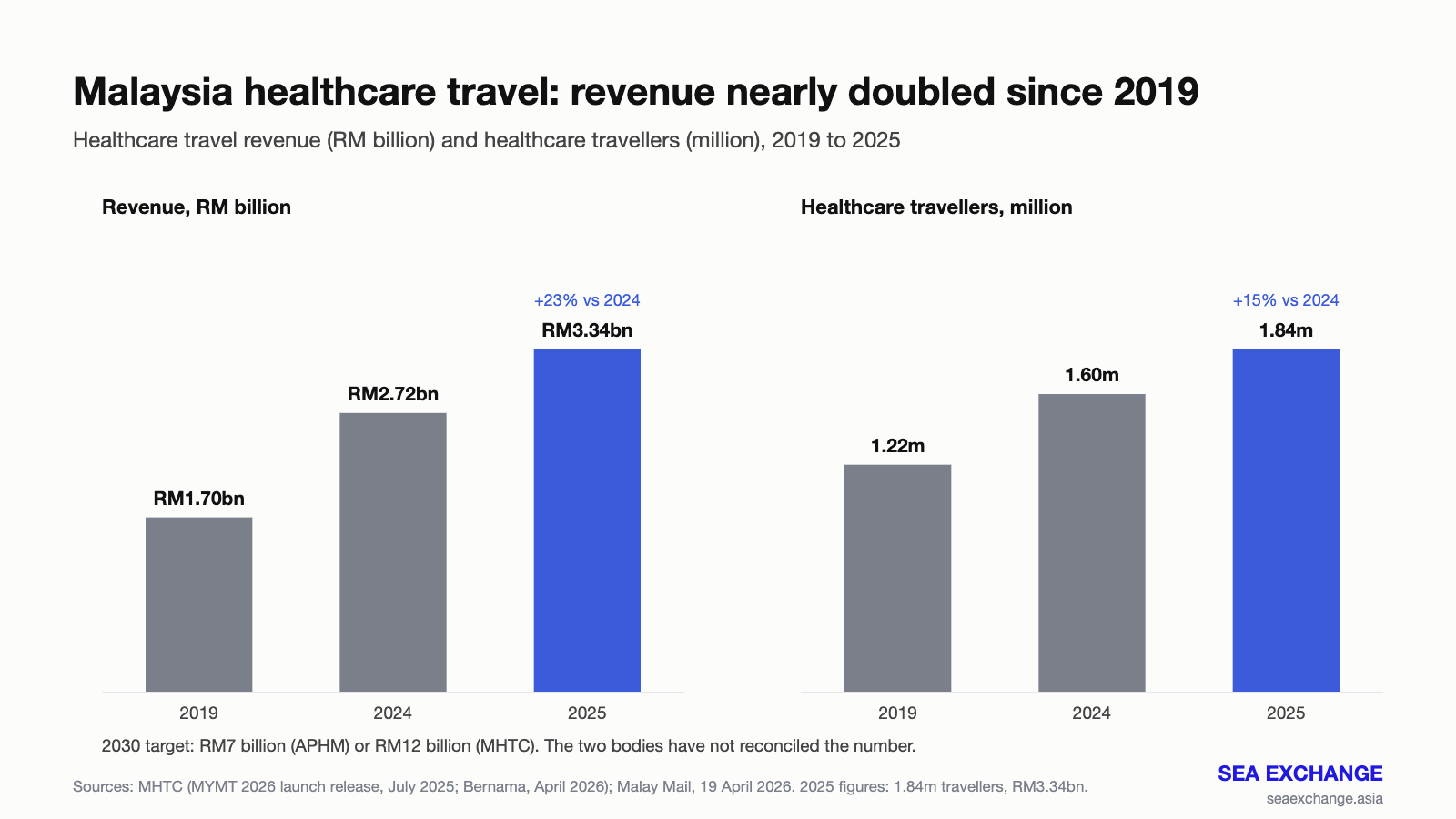
- Malaysia recorded 1.84 million healthcare travellers and RM3.34 billion in revenue in 2025, up about 23% on 2024, going into the campaign year.
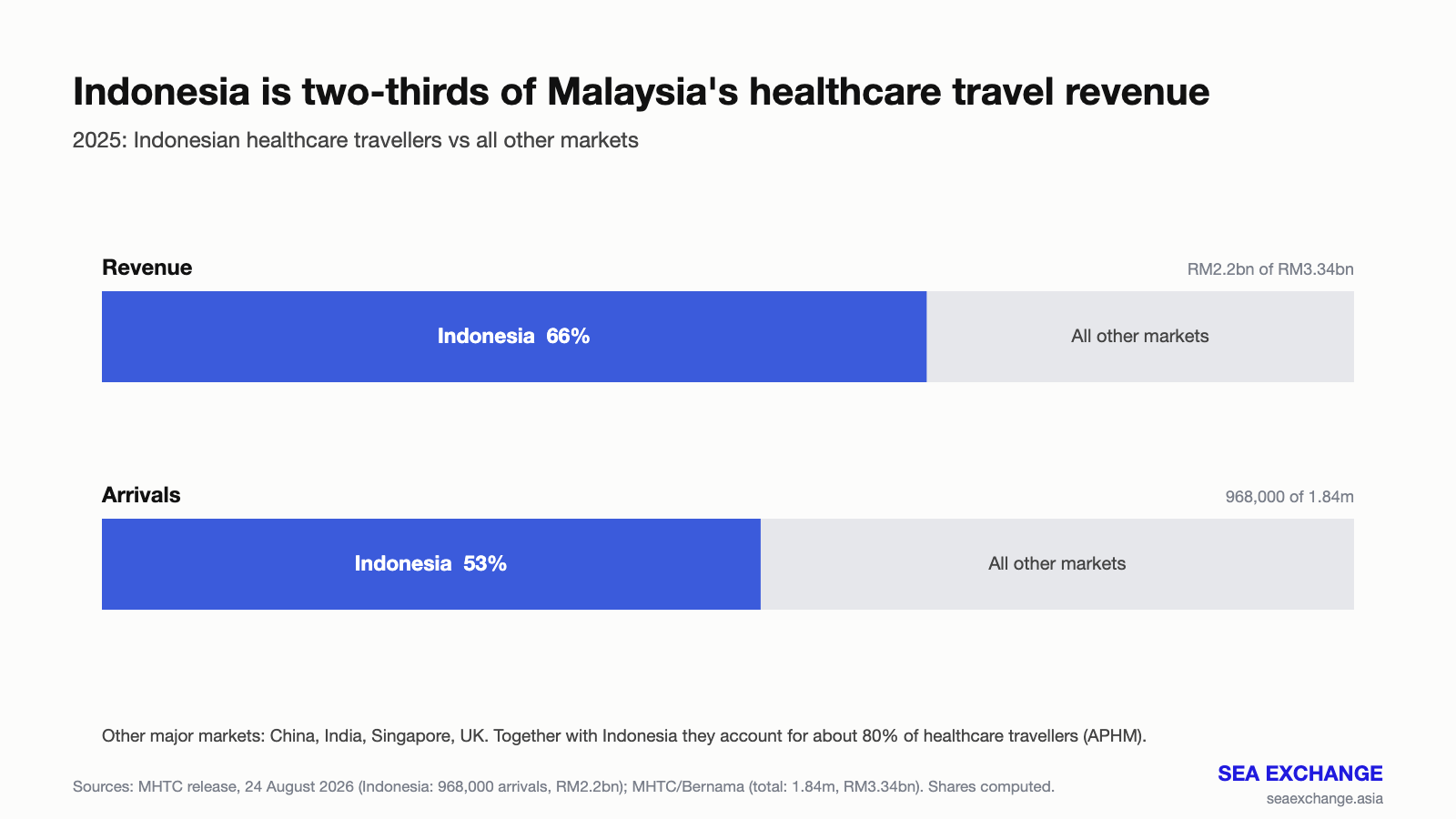
- Indonesia alone delivered 968,000 arrivals and RM2.2 billion in 2025, roughly two-thirds of all healthcare travel revenue.
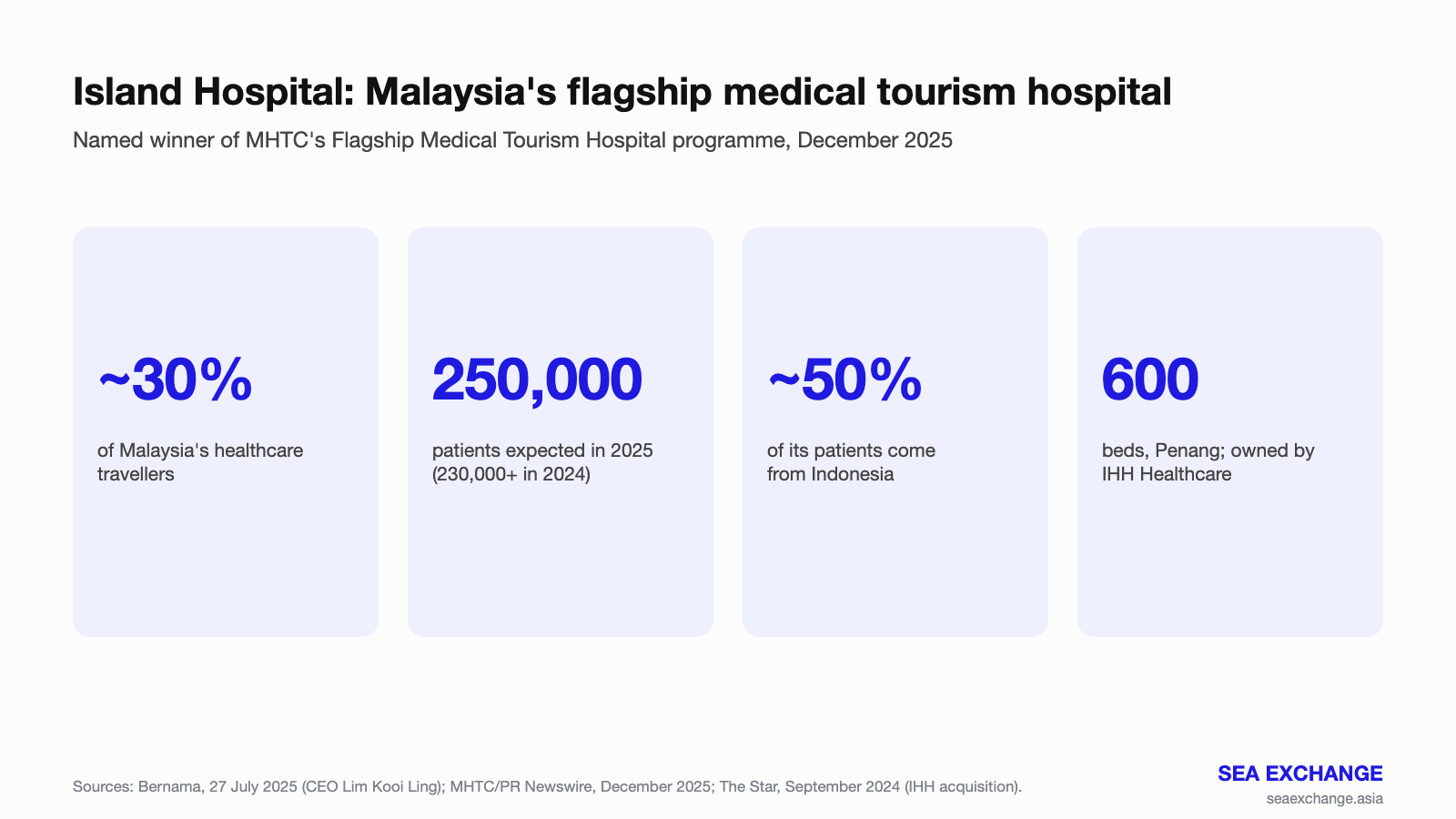
- Island Hospital Penang was named Malaysia’s first Flagship Medical Tourism Hospital on 9 December 2025 and handles close to 30% of the country’s healthcare travellers.
- Official 2030 revenue targets range from RM7 billion (private hospital association) to RM12 billion (MHTC at the MYMT launch). Nobody has reconciled the two.
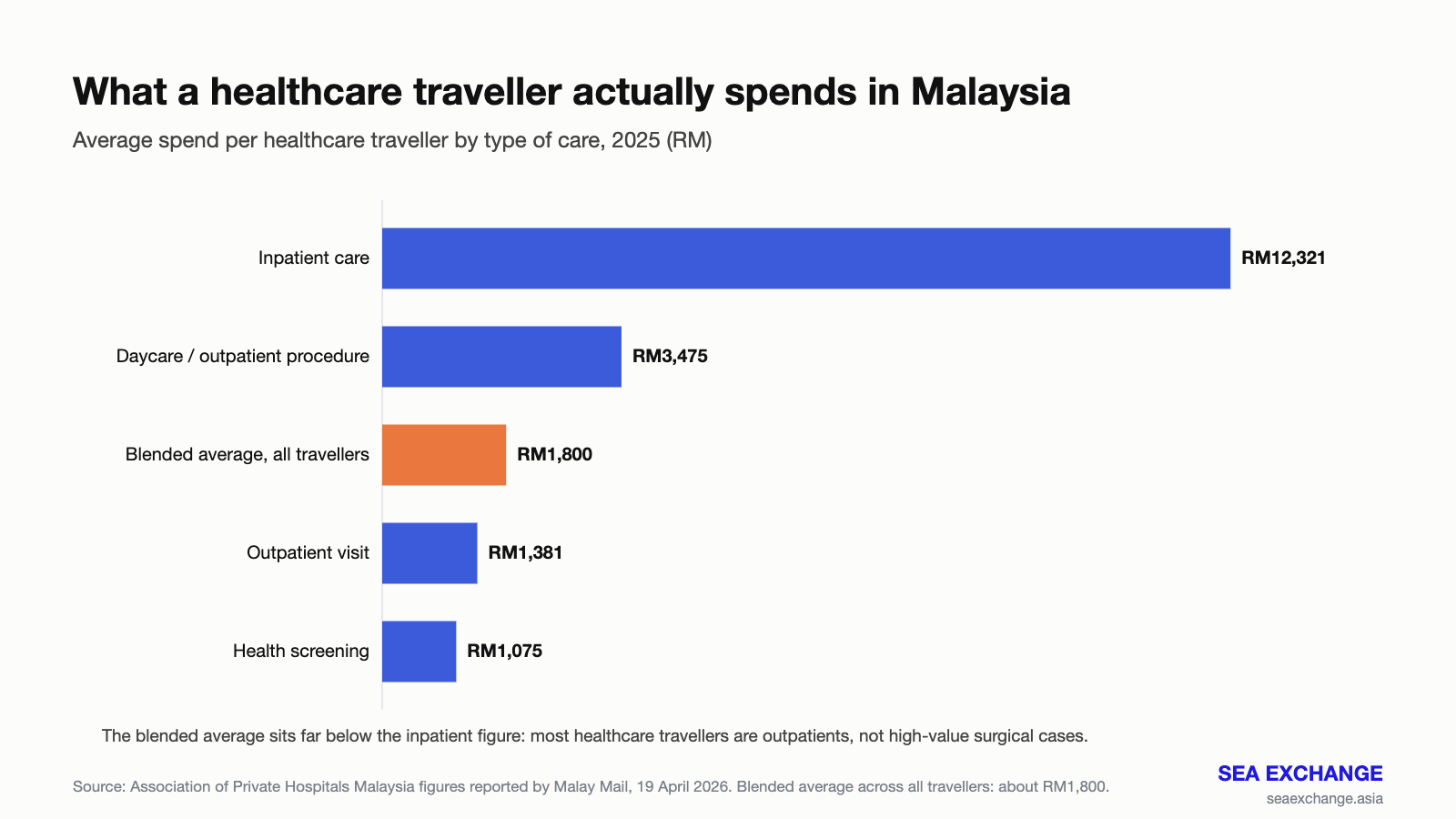
- The average healthcare traveller spends about RM1,800 on treatment. Most are regional outpatients, not high-value inpatients, and that is the campaign’s real challenge.
What MYMT 2026 is, and why it exists
The Malaysia Healthcare Travel Council (MHTC), an agency under the Ministry of Health, launched the Malaysia Year of Medical Tourism 2026 on 25 July 2025 at MITEC in Kuala Lumpur. It is the first time the country has dedicated a full calendar year to promoting healthcare travel, and it deliberately runs alongside Visit Malaysia 2026, the tourism ministry’s campaign targeting 35.6 million visitor arrivals.
The campaign tagline is “Healing Meets Hospitality”. Dato’ Seri Siti Nurhaliza was appointed ambassador, a choice that signals exactly which market the campaign is chasing: Indonesian and Malay-speaking patients who already know her name.
The stated aim is to move Malaysia from a regional healthcare destination to a globally recognised one. The numbers below show how far along that journey the country is, and how far it is not.
The scorecard: arrivals and revenue
| Year | Healthcare travellers | Revenue | Growth (revenue) |
|---|---|---|---|
| 2019 (pre-pandemic) | 1.22 million | RM1.7 billion | Baseline |
| 2024 | 1.6 million | RM2.72 billion | +21% vs 2023 |
| 2025 | 1.84 million | RM3.34 billion | +23% vs 2024 (computed) |
| 2030 target (APHM) | Not stated | RM7 billion | About 2.1x on 2025 |
| 2030 target (MHTC, at MYMT launch) | Not stated | RM12 billion | About 3.6x on 2025 |
Sources: MHTC MYMT 2026 launch release (July 2025); MHTC via Bernama (April 2026); Malay Mail, “Prescribing growth”, 19 April 2026. Some outlets round 2025 to 1.8 or 1.85 million travellers and RM3.35 billion; the MHTC figures are used here. The 23% growth rate is computed from MHTC’s 2024 and 2025 totals.
Revenue has almost doubled since 2019 while arrivals grew about 52%, which means spend per traveller is rising. That is the number MHTC likes to quote. The less flattering reading is that part of the revenue jump reflects medical inflation and the 6% service tax applied to private healthcare for foreigners from 2025, not purely more demand. Both things are true at the same time.
Where the patients come from
Indonesia is not just the largest source market. It is the market. In 2025, Indonesian healthcare travellers to Malaysia hit a record 968,000 arrivals (up 16%) and RM2.2 billion in revenue (up 24%). Against national totals, that is roughly 52% of arrivals and about two-thirds of revenue from a single country.
The remaining volume comes largely from China, India, Singapore and the United Kingdom. The Association of Private Hospitals Malaysia (APHM) says these five markets together account for around 80% of healthcare travellers.
MHTC has leaned into the concentration rather than away from it. Its Malaysia Healthcare Expo (MHX) returned to Yogyakarta from 20 to 23 August 2026 with more than 15 member hospitals, following Malaysia Fair Jakarta in May. Rahmatullah Baragau, MHTC’s Head of Indonesia Market, called Indonesia “Malaysia Healthcare’s closest and most valued market”. That is the honest description of the business.
Who is actually winning
Island Hospital, Penang
On 9 December 2025 MHTC named Island Hospital the winner of its Flagship Medical Tourism Hospital (FMTH) programme, a four-year evaluation run with Joint Commission International and IQVIA. The other three finalists, Institut Jantung Negara, Mahkota Medical Centre in Melaka and Subang Jaya Medical Centre, received category accolades.
Island Hospital’s scale explains the result. CEO Lim Kooi Ling has said the 600-bed hospital handled over 230,000 patients in 2024, expected 250,000 in 2025, and accounts for nearly 30% of Malaysia’s total healthcare travellers, with about half its patients coming from Indonesia. Island Hospital was acquired by IHH Healthcare, which also owns the Gleneagles and Pantai networks, and holds adjacent land for further expansion.
The listed hospital groups
Three groups dominate private healthcare capacity: IHH Healthcare, Sunway Healthcare and KPJ Healthcare. APHM estimates around 80 of Malaysia’s 212 private hospitals are active in medical tourism. MHTC’s membership has grown from 82 hospitals at the MYMT launch to 91 by August 2026.
The states
Penang remains the medical tourism capital by volume. Melaka (Mahkota) and Johor are the other active hubs, with Johor investing in access and infrastructure to capture Singapore-adjacent demand. Kuala Lumpur competes on tertiary care through IJN, Prince Court, Sunway Medical Centre and SJMC, and KL Wellness City’s international hospital was targeted for a Q3 2026 opening, not yet confirmed at time of writing.
What a healthcare traveller actually spends
| Category | Average spend (2025) |
|---|---|
| Inpatient care | RM12,321 |
| Daycare / outpatient procedure | RM3,475 |
| Outpatient visit | RM1,381 |
| Health screening | RM1,075 |
| All healthcare travellers (blended) | About RM1,800 |
| Non-medical spend per companion (hotels, food, transport), 2024 figure | RM2,680 |
Source: APHM figures reported by Malay Mail, 19 April 2026. Treatment averages are 2025; companion spend is the 2024 figure quoted in the same report.
This table is the most important one in the piece. A blended average of RM1,800 per traveller against an inpatient average of RM12,321 tells you that the large majority of “medical tourists” are outpatients, many of them coming for screening or consultations. Datuk Dr Kuljit Singh, APHM president, argues every ringgit spent by a healthcare tourist generates up to four times that in wider economic activity, which is the case for counting companions and hotel nights. Critics such as analyst Murray Hunter argue the opposite: that MHTC counts every foreign passport holder treated in a member hospital, and that a RM2,000 average spend is evidence the headline numbers overstate genuine medical tourism.
Both readings lead to the same strategic conclusion. Malaysia has won the regional volume game. The next RM4 billion, whichever 2030 target you believe, has to come from higher-value inpatient work: cardiology, oncology, orthopaedics and fertility, sold to patients who would otherwise choose Singapore or Bangkok.
Scorecard: what is working and what is not
Working
- Growth rate: revenue up 23% in the run-up year, ahead of the 2019 to 2025 trend.
- Indonesia depth: record arrivals and spend, with MHTC events in Jakarta and Yogyakarta keeping the pipeline warm.
- Flagship credibility: the FMTH award gives Malaysia one hospital it can market as a JCI- and IQVIA-evaluated national champion.
- Price positioning: Malaysian executive health screenings cost a fraction of Singapore’s and undercut Bangkok. (See our companion piece on screening prices across KL, Singapore and Bangkok.)
Not yet working
- Target clarity: RM7 billion and RM12 billion cannot both be the 2030 goal. The campaign would be stronger with one number and a published path to it.
- Market concentration: two-thirds of revenue from Indonesia is a strength until Jakarta builds enough private capacity of its own. Diversification into China, India and the Middle East is talked about more than it is measured.
- Competitive marketing: Thailand’s government claims around three million foreign patients a year; independent estimates of genuine medical tourists range from roughly 580,000 (Nation Thailand, 2026) to 1.5 million (ISEAS, 2025). Whichever figure you take, Thailand markets on a global brand while Malaysia markets regionally, and Singapore owns the premium tier. Malaysia’s international marketing reach is still described by industry observers as relatively weak.
- Patient protection: overseas patients have limited recourse in malpractice disputes and there is no standard international patient insurance product. Unregulated agents in some source markets have produced reputational damage.
- Data transparency: MHTC publishes annual totals but not a consistent breakdown by treatment type, source market and state. That makes it hard for hospitals, investors or media to judge the campaign as it runs.
What to watch between now and December
- Whether MHTC publishes first-half 2026 figures. A campaign year without mid-year data is a marketing exercise, not a scorecard.
- KL Wellness City’s hospital opening: the developer said in early 2025 it was on track for Q3 2026. No opening has been confirmed as of September 2026.
- Any second-source-market push (China, India or the Gulf) that comes with a number attached rather than a memorandum.
- Budget 2027 in October: whether the healthcare travel tax treatment changes, and whether MHTC’s funding rises for the post-campaign years.
- Island Hospital’s expansion plans on its adjacent land, the single largest capacity lever in the system.
The bottom line
MYMT 2026 inherited real momentum: 23% revenue growth, a record Indonesian year, and a flagship hospital with international validation. What it has not yet done is change the shape of the business. Malaysia is still a high-volume, mid-value, single-market healthcare destination. The campaign will be judged a success if, by December, it can show inpatient revenue and non-Indonesian arrivals growing faster than the headline totals. If it can only show the headline totals, 2026 was a good year for the trend, not for the strategy.
FAQ
How many medical tourists visited Malaysia in 2025?
About 1.84 million healthcare travellers, generating RM3.34 billion in revenue, according to MHTC figures reported in 2026.
Which country sends the most medical tourists to Malaysia?
Indonesia, with 968,000 healthcare traveller arrivals and RM2.2 billion in spend in 2025, about two-thirds of Malaysia’s healthcare travel revenue.
What is Malaysia’s flagship medical tourism hospital?
Island Hospital in Penang, named winner of MHTC’s Flagship Medical Tourism Hospital programme on 9 December 2025.
What is Malaysia’s medical tourism revenue target for 2030?
Two figures are in circulation: RM7 billion, cited by the Association of Private Hospitals Malaysia, and RM12 billion, cited by MHTC at the MYMT 2026 launch.
Is medical treatment in Malaysia cheaper than Singapore?
Yes, substantially. Published executive health screening packages in Kuala Lumpur cost roughly a quarter to a sixth of comparable packages at Singapore private hospitals at current exchange rates. Detailed comparison in our companion article.
Sources
- MHTC, “Malaysia Healthcare Travel Council launches MYMT 2026”, PR Newswire, 25 July 2025
- Malay Mail, “Prescribing growth: Private hospitals drive Malaysia’s RM7b medical tourism ambition”, 19 April 2026
- PR Newswire / Manila Times, “Indonesian healthcare travel to Malaysia hits record RM2.2 billion as MHX returns to Yogyakarta”, 24 August 2026
- IHH Healthcare media release, “Island Hospital named Malaysia’s first Flagship Medical Tourism Hospital”, 9 December 2025; MHTC / PR Newswire release, 10 December 2025
- MHTC via Bernama MREM, healthcare travel figures for 2025, April 2026
- ISEAS Yusof Ishak Institute, Economics Working Paper 2025-3 on Thai medical tourism; Nation Thailand, 2026
- Bernama, “Island Hospital positions itself to ride 2026 medical tourism wave, CEO”, 27 July 2025
- Travel And Tour World, “Malaysia strengthens global medical tourism appeal”, 21 May 2026
- The Vibes, Murray Hunter, “Malaysia’s medical tourism: the many challenges”, 27 April 2026
- Vulcan Post, “KL Wellness City’s international hospital is set to launch in 2026”