


Malaysia’s second-quarter GDP was revised up to 6.0%, beating both the advance estimate and Bank Negara’s own full-year forecast. Here is the full sector-by-sector breakdown, why the economy is outperforming, and what it signals for businesses, investors, and the rest of 2026.
Key facts at a glance
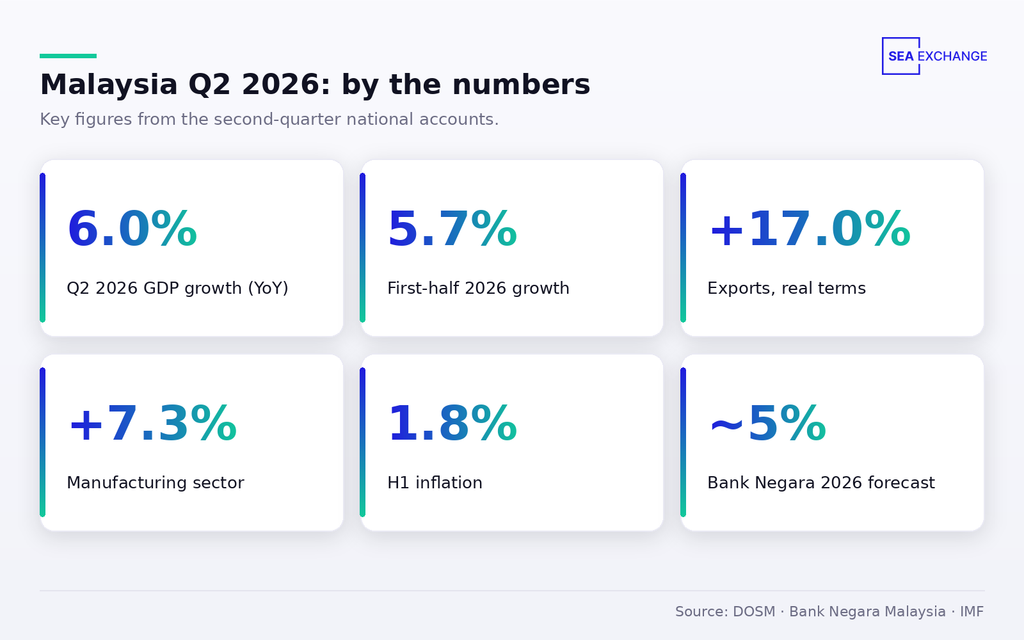
- Malaysia’s real GDP grew 6.0% year-on-year in Q2 2026, revised up from the 5.8% advance estimate.
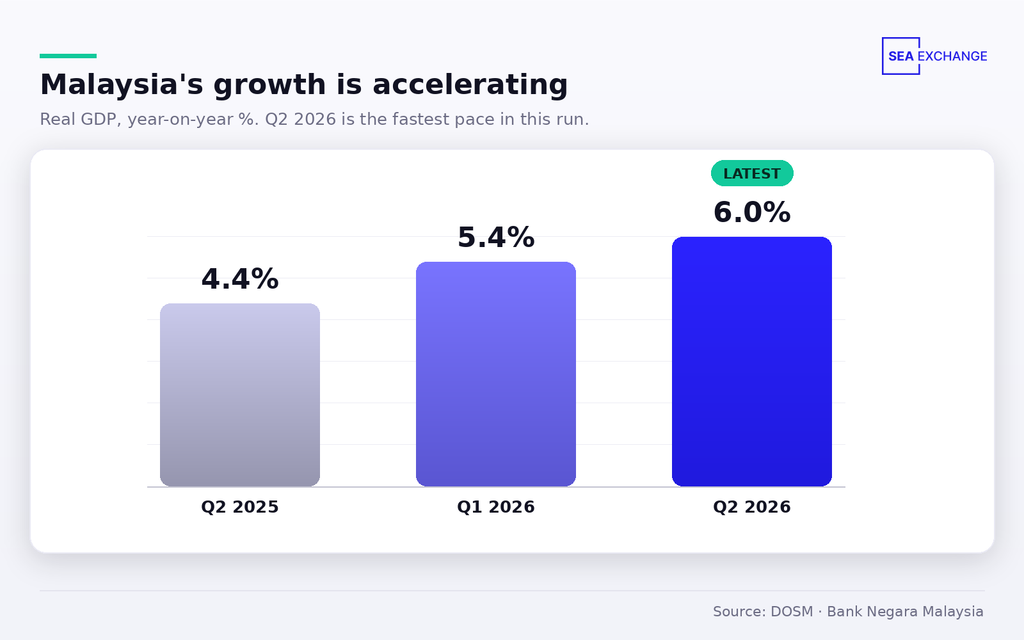
- Growth accelerated from 5.4% in Q1 2026 and 4.4% in Q2 2025.
- First-half (H1) 2026 growth reached 5.7%, up from 4.5% in H1 2025.
- On a seasonally adjusted quarter-on-quarter basis, the economy expanded 2.5%.
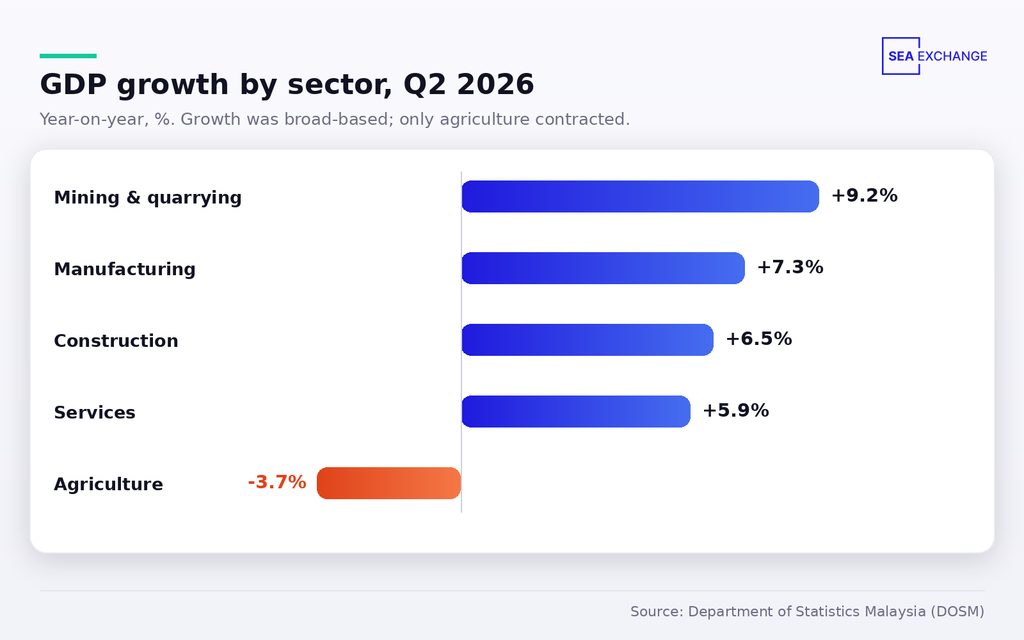
- Growth was broad-based: manufacturing (+7.3%), mining (+9.2%), construction (+6.5%) and services (+5.9%) all expanded, while only agriculture contracted (-3.7%).
- Exports jumped 17.0% in real terms, led by electrical and electronics (E&E).
- Inflation stayed low at 1.9% in Q2 (1.8% for H1), the ringgit held stable, and Moody’s kept Malaysia’s A3 rating.
- Bank Negara expects around 5% growth for full-year 2026, while the IMF has upgraded its forecast to 4.7%.
Sources: Department of Statistics Malaysia (DOSM), Bank Negara Malaysia (BNM). Figures as reported August 2026.
Malaysia posts its strongest quarter in years
Malaysia’s economy expanded 6.0% year-on-year in the second quarter of 2026, according to figures confirmed by the Department of Statistics Malaysia (DOSM) and Bank Negara Malaysia (BNM) in August. The final reading was revised upward from the 5.8% advance estimate released in July, a rare and telling upgrade that underscores how strongly the quarter closed.
The number matters for three reasons. First, it accelerated from 5.4% in Q1 2026 and 4.4% a year earlier, confirming genuine momentum rather than a one-off. Second, it lifted first-half 2026 growth to 5.7%, comfortably ahead of Bank Negara’s original full-year projection of 4 to 5%. Third, the growth was broad-based, with nearly every major sector contributing, which economists generally read as a more durable and less fragile kind of expansion than growth driven by a single sector.
Finance Minister II Datuk Seri Amir Hamzah Azizan said the country’s economic fundamentals “remain resilient” despite global headwinds. Bank Negara Governor Abdul Rasheed struck a similarly measured tone, describing demand as “steady, resilient, but not excessive,” a signal of growth without overheating.
The sector-by-sector breakdown
What makes Q2 2026 notable is its breadth. Here is how each major sector performed year-on-year:
| Sector | Q2 2026 growth | Notes |
|---|---|---|
| Mining & quarrying | +9.2% | Natural gas production up 19.3% |
| Manufacturing | +7.3% | E&E and optical products up 14.4% |
| Construction | +6.5% | Supported by data-centre and infrastructure builds |
| Services | +5.9% | Led by ICT and data-centre operations |
| Agriculture | -3.7% | Dragged down by oil palm output (-9.5%) |
Manufacturing was the standout, accelerating from 5.9% in Q1 as global demand for electrical and electronic products, Malaysia’s export backbone, stayed strong. Mining surprised on the upside thanks to a surge in natural gas production. Services, the largest slice of the economy, kept expanding on the back of information and communications technology (ICT) and the fast-growing data-centre segment. The lone laggard was agriculture, where a sharp drop in oil palm production pulled the sector into contraction.
What consumers, government, and exporters contributed
On the demand side, growth was similarly well-distributed:
- Private consumption rose 4.8% and remains the engine of the economy at 60.3% of GDP, with households spending steadily.
- Government spending jumped 7.6%, up sharply from 4.1% in Q1.
- Investment (gross fixed capital formation) grew 4.6%, supported by continued capital inflows. Malaysia approved RM92.8 billion in investments in Q1 alone.
- Exports surged 17.0% in real terms (versus 5.2% in Q1), with imports up 13.9%, producing a large positive contribution from net trade.
The picture is a healthy one: consumption providing the stable base, exports providing the upside, and investment, much of it tied to the data-centre and digital-infrastructure boom, building future capacity.
Low inflation and a stable ringgit round out the story
Strong growth did not come at the cost of price stability. Headline inflation was just 1.9% in Q2 (1.6% in Q1), averaging 1.8% across the first half, modest by regional and historical standards and driven largely by higher fuel prices following subsidy adjustments rather than broad-based overheating. Core inflation actually eased to 1.9%.
The ringgit held stable through the first seven months of the year, Moody’s maintained Malaysia’s A3 rating with a stable outlook, and Malaysia climbed eight places to 15th in the 2026 IMD World Competitiveness Ranking. Together, these signals reinforce the narrative of an economy that is growing quickly and soundly.
The outlook: can Malaysia keep it up?
Bank Negara expects full-year 2026 growth of around 5%, with Governor Abdul Rasheed noting it will “most likely be around five per cent,” possibly slightly above or below. The International Monetary Fund upgraded its forecast to 4.7% in April 2026, up from 4.3% in January, and held it there through mid-year.
For the second half, the central bank expects consumption, investment, exports, and tourism to keep supporting activity, even as the mix of drivers shifts. The upside risks include sustained global demand for E&E products and a stronger-than-expected tourism year, with Malaysia running its Visit Malaysia 2026 campaign and recording more than 21 million arrivals in H1. The downside risks are largely external: geopolitical tension, softer global demand, and the ongoing uncertainty around global trade and tariffs.
Why it matters for businesses and investors
For anyone operating in or eyeing Malaysia, the Q2 print is more than a headline number. It is a signal. A broad-based 6.0% expansion with low inflation, a stable currency, and an improving competitiveness ranking is precisely the backdrop that supports expansion decisions, hiring, and capital deployment. The concentration of growth in manufacturing (E&E), ICT, and data-centre-linked services also tells you where the momentum is: Malaysia’s positioning as a regional digital-infrastructure and high-value manufacturing hub is showing up directly in the national accounts.
The one structural watch-item is agriculture’s contraction and Malaysia’s continued exposure to external demand, a reminder that the economy’s strength is real but not immune to global shocks.
Frequently asked questions
What was Malaysia’s GDP growth in Q2 2026?
Malaysia’s economy grew 6.0% year-on-year in the second quarter of 2026, revised up from an advance estimate of 5.8%.
How does that compare to Q1 2026 and to 2025?
It accelerated from 5.4% in Q1 2026 and 4.4% in Q2 2025. First-half 2026 growth was 5.7%, up from 4.5% in H1 2025.
What drove Malaysia’s Q2 2026 growth?
Growth was broad-based. Manufacturing (+7.3%, led by electrical and electronics), mining (+9.2%), construction (+6.5%) and services (+5.9%) all expanded, while exports rose 17.0% and private consumption grew 4.8%. Only agriculture contracted (-3.7%).
What is Malaysia’s GDP growth forecast for 2026?
Bank Negara Malaysia expects around 5% for the full year, while the IMF forecasts 4.7%. Both are above Bank Negara’s original 4 to 5% projection.
What is Malaysia’s inflation rate in 2026?
Inflation averaged 1.8% in the first half of 2026 (1.9% in Q2), among the lower rates in the region.
Who reports Malaysia’s GDP figures?
The Department of Statistics Malaysia (DOSM) publishes the official GDP data, with economic commentary from Bank Negara Malaysia (BNM), the central bank.
Sources
Bank Negara Malaysia – Q2 2026 economic developments
BERNAMA – Malaysia’s economy grows 6.0% in Q2 2026
New Straits Times – Q2 GDP beats advance estimate
New Straits Times – BNM expects 5% for 2026
Malay Mail – Economy beats expectations
Human Resources Online – sector breakdown