

Visit Malaysia 2026 is tracking well: 21 million arrivals in the first half, comfortably above pre-pandemic levels. But the official data tells a more specific story than the “global tourism magnet” headlines suggest. The growth is coming from Malaysia’s own backyard, led by an unlikely trio. Here is the demand-side breakdown brands, hotels and tourism boards should actually plan around.
Malaysia is on course for a strong Visit Malaysia 2026. In the first half of the year the country logged 21.12 million international visitor arrivals, up 2.5 percent year on year and running about 17.7 percent ahead of 2019, a genuine, above-pre-pandemic recovery. For the January to May window, Tourism Malaysia put arrivals at 17.5 million, up 3.4 percent.
So the honest headline is not “boom” or “bust.” It is this: Malaysia is winning, but it is winning a regional game. And for anyone selling to travellers, whether hotels, malls, airlines, tourism boards, F&B or experiences, understanding who is actually arriving matters far more than the top-line number.
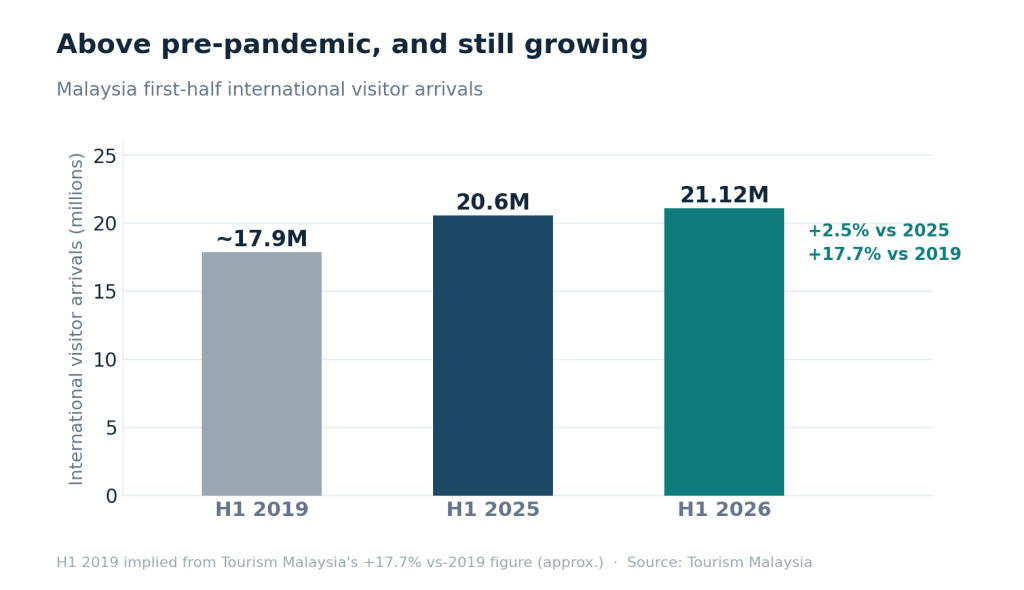
Malaysia’s first-half arrivals are above 2019 levels and still climbing, though growth has cooled to a steady pace.
First, the target nobody agrees on
Before the composition, a fact worth pinning down, because it shapes how you read every other number: Malaysia is quietly running two different targets for 2026.
Tourism Malaysia’s official strategic roadmap sets the goal at 35.6 million tourist arrivals and RM147.1 billion in receipts. Yet Tourism Minister Tiong King Sing and much subsequent coverage have publicly cited a far higher 47 million figure. Both numbers are in official circulation. One is the planning target, the other the campaign’s aspirational ceiling.
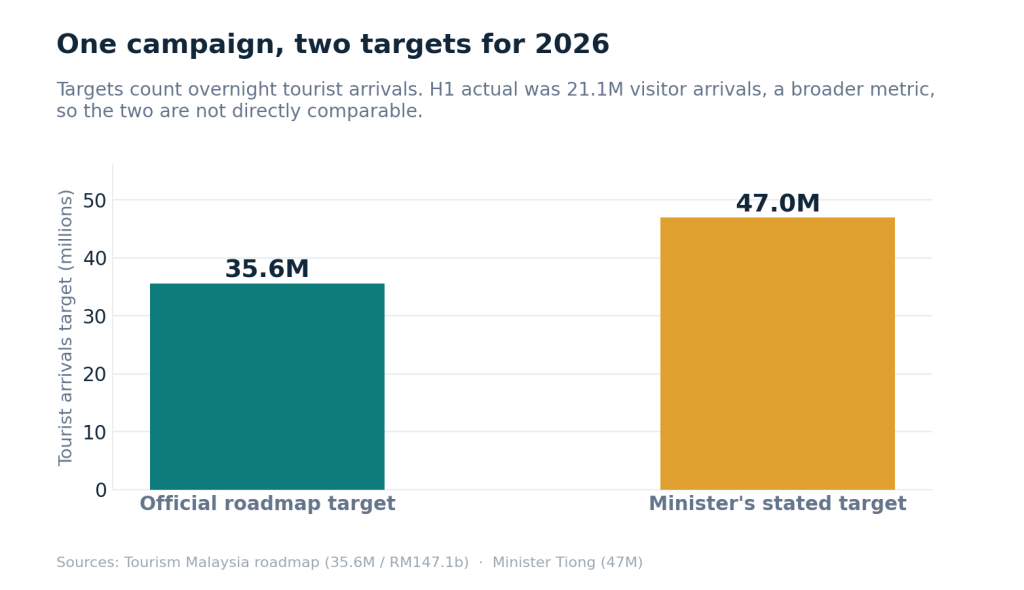
Same country, same data, two different targets. Which one you use decides whether Malaysia is ahead of pace or behind.
The gap matters commercially. Measured against 35.6 million tourist arrivals, Malaysia is tracking ahead of pace. Measured against 47 million, it is tracking behind. That is precisely why you should anchor your own planning to the metric and target you actually name, and treat the 47 million figure as ambition rather than forecast.
One definitional trap: “visitor arrivals” includes same-day excursionists, while “tourist arrivals” counts overnight stays. The 21 million H1 figure is visitor arrivals. The 35.6 and 47 million targets are tourist arrivals. Mixing them is the single most common error in Malaysia tourism coverage.
The composition story: ASEAN is nearly three-quarters of the market
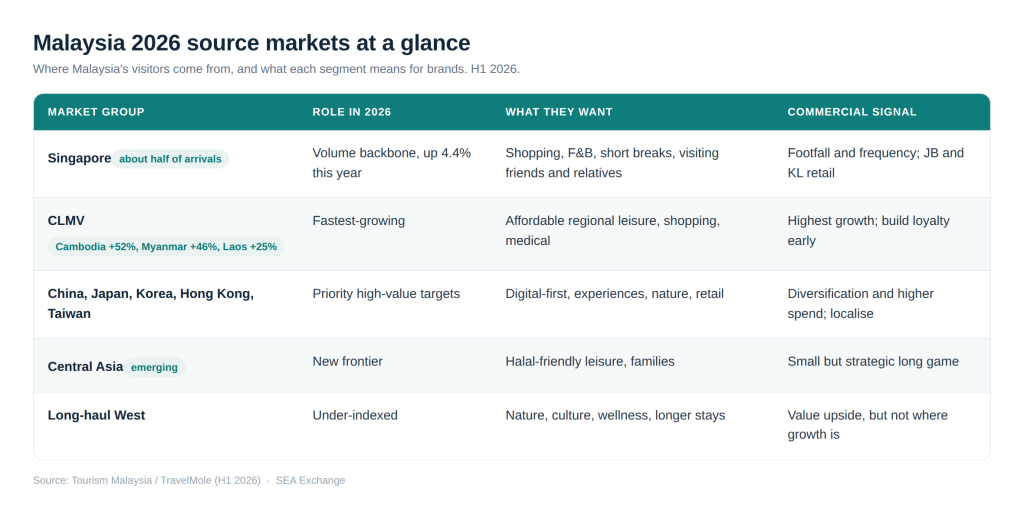
Here is the fact the “global magnet” framing tends to bury: ASEAN markets accounted for 72.8 percent of Malaysia’s international arrivals in H1 2026. Singapore remains the single largest source by a wide margin, historically around half of all arrivals, and grew a further 4.4 percent this year.

ASEAN made up 72.8 percent of Malaysia’s H1 2026 arrivals, with Singapore alone historically close to half.
This is Malaysia’s structural advantage and its structural risk in one number. The Causeway delivers enormous, reliable, high-frequency volume: weekend shoppers, day-trippers, and visiting-friends-and-relatives traffic. But it also means Malaysia’s “international tourism” is overwhelmingly regional and short-haul, with the lower per-visitor spend that implies. A Singaporean crossing to Johor Bahru for a day of shopping is a fundamentally different commercial customer than a long-haul visitor booking a week in Langkawi.
For brands, the split is the strategy: the volume business and the value business are two different businesses. Optimise for footfall and you follow Singapore and intra-ASEAN traffic. Optimise for spend and length of stay and you have to work harder, because the highest-spending long-haul segments are not where the growth is right now.
The real 2026 surprise: the CLMV surge
The standout growth stories of H1 2026 are not China or the West. They are Malaysia’s near neighbours: Cambodia up 52.3 percent, Myanmar up 45.9 percent, and Laos up 25.4 percent.
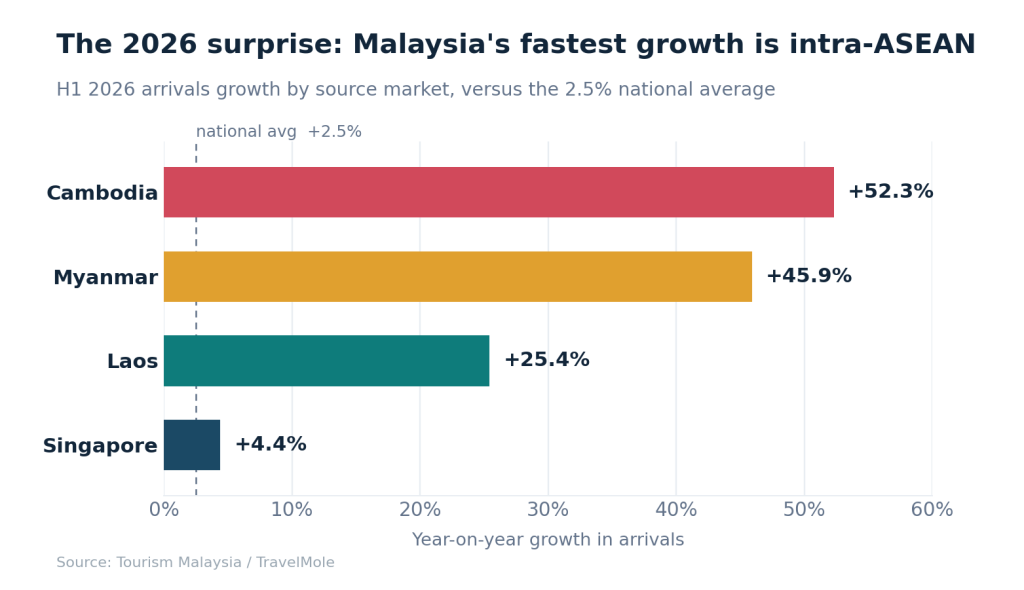
Malaysia’s fastest-growing source markets in 2026 are all regional neighbours, far outpacing the 2.5 percent national average.
This intra-ASEAN, “CLMV” (Cambodia, Laos, Myanmar, Vietnam) acceleration is one of the most underreported dynamics in Southeast Asian travel. It is the product of cheaper regional air links, visa ease, rising middle classes, and Malaysia’s positioning as an accessible, halal-friendly, mid-cost regional hub. These are not huge markets in absolute terms yet, but they are the fastest-moving, and they are loyal and repeat-prone once established.
Alongside them, Tourism Malaysia has explicitly named its high-potential focus markets as China, Japan, South Korea, Hong Kong and Taiwan, plus emerging Central Asian markets such as Uzbekistan, Kazakhstan and Turkmenistan, a deliberate tilt toward North and Central Asia to diversify beyond the ASEAN core and lift average spend.
The headwind Tourism Malaysia named itself
The main brake on stronger numbers is external. Tourism Malaysia director-general Mohd Amirul Rizal was explicit: “If not for the conflict in the Middle East, we could have targeted even stronger growth. Nevertheless, the 3.4 per cent increase shows that Malaysia’s tourism industry remains resilient.” The Middle East conflict raises jet-fuel costs and suppresses long-haul demand, and domestic pump prices ticked up in early August, with RON95 at RM3.82.
The second pressure is competition. Vietnam posted record arrivals in early 2026, and Thailand has openly pivoted to a “quality tourism” model, chasing higher-spending visitors over raw volume after trimming its own arrival target. Malaysia’s challenge is the same one facing the whole region: not filling planes, but raising the value of each seat.
What this means if you sell to travellers
Hotels and resorts: Plan for a barbell. High-frequency short-stay regional volume at one end, a growing but service-sensitive North Asian segment at the other. Margin lives in converting the second group through localisation, not discounting for the first.
Retail and malls: Singapore and the CLMV markets drive frequency and convenience; North Asian visitors drive experience and status. Merchandising and payments should reflect both.
Airlines and connectivity: The CLMV surge is a route-network opportunity worth pressing now; the North Asia targets are the higher-yield bet.
Tourism boards and destinations: The winning message is not “come to Malaysia.” It is a reason to travel beyond Johor Bahru: Langkawi, Penang, Borneo, wellness, and Malaysia’s medical-tourism proposition, a natural cross-sell with the government’s MYMT 2026 push.
Malaysia will very likely post a record year in absolute arrivals. The more useful question for 2026 is not which target it hits. It is whether the country can shift its mix toward higher-value visitors before its neighbours do.
Frequently asked questions
How many tourists is Malaysia expecting in 2026?
Tourism Malaysia’s official roadmap targets 35.6 million tourist arrivals and RM147.1 billion in receipts for Visit Malaysia 2026, though the Tourism Minister has publicly cited a higher 47 million figure. In the first half of 2026, Malaysia recorded 21.12 million international visitor arrivals, up 2.5 percent year on year and about 17.7 percent above 2019 levels.
Where do most of Malaysia’s tourists come from?
ASEAN markets accounted for 72.8 percent of arrivals in H1 2026, with Singapore the largest single source, historically around half of all arrivals, up 4.4 percent this year. The fastest-growing markets in 2026 were Cambodia (+52.3%), Myanmar (+45.9%) and Laos (+25.4%).
Is Malaysia’s tourism actually booming in 2026?
Malaysia is on track for a record year: H1 2026 arrivals rose 2.5 percent to 21.12 million, above pre-pandemic levels. But growth is moderate and heavily concentrated in regional, short-haul markets, and is constrained by Middle East driven fuel costs and stronger regional competition.
Which foreign markets is Malaysia targeting for growth?
Tourism Malaysia has named China, Japan, South Korea, Hong Kong and Taiwan as high-potential focus markets, plus emerging Central Asian markets such as Uzbekistan, Kazakhstan and Turkmenistan, a push to diversify beyond the ASEAN core and raise average visitor spend.
Which Malaysian destinations benefit most?
Kuala Lumpur and Johor, via Singapore day-trip and shopping traffic, capture the volume. Higher-value growth depends on drawing visitors into longer stays in Penang, Langkawi and Borneo, and into wellness and medical tourism.
Malay Mail / Tourism Malaysia, international arrivals rise 3.4pc to 17.5 million (Jan to May 2026): https://www.malaymail.com/news/malaysia/2026/07/08/malaysias-international-arrivals-rise-34pc-to-175-million-despite-global-challenges-says-tourism-malaysia/226828
TravelMole, Malaysia tops 21 million international arrivals in H1 2026: https://travelmole.com/news/malaysia-tourism-growth-h1-2026
Tourism Malaysia, Strategic Roadmap for Visit Malaysia 2026 (35.6 million; RM147.1 billion): https://www.tourism.gov.my/media/view/tourism-malaysia-unveils-strategic-roadmap-for-visit-malaysia-2026
New Straits Times / Bernama, Minister Tiong’s 47 million reference: https://www.nst.com.my/news/nation/2025/11/1317430/tiong-malaysia-track-welcome-47mil-tourists-2026
The Edge Malaysia, tourist arrivals rose 5.4% to 10.65 mil in Jan to Mar 2026: https://theedgemalaysia.com/node/803354
The Star, Fewer tourists likely in 2H: https://www.thestar.com.my/business/business-news/2026/07/22/fewer-tourists-likely-in-2h