

Quick answer: Malaysia’s EV market has crossed into the mainstream. EVs made up 6.95% of new-vehicle registrations in Q1 2026, roughly one in every 14 new cars, after sales jumped 109% in 2025 to 30,848 units. The market is now led by a home-grown brand (Proton e.MAS), the CBU import-duty exemption expired at the end of 2025, road tax is no longer free, and the public charging network sits at about 5,360 chargers, well short of the government’s 10,000 target.
The state of play: how big is Malaysia’s EV market in 2026?
For years, Malaysia’s EV market was a rounding error. That is no longer true. In 2025, Malaysians bought 30,848 fully electric vehicles, a 109% increase over the 14,766 sold in 2024. Add 38,515 hybrids and the country registered 69,363 electrified vehicles in a single year. The momentum carried into 2026: the first quarter alone saw 14,591 EV registrations, up 113.7% year-on-year, pushing EV market share to just under 7%.
Two forces drove the 2025 surge. The first was a genuine broadening of choice and falling prices. The second was a deadline: buyers rushed to take delivery before the fully-imported (CBU) tax exemption expired on 31 December 2025. That pull-forward matters: some of 2025’s growth was borrowed from 2026.
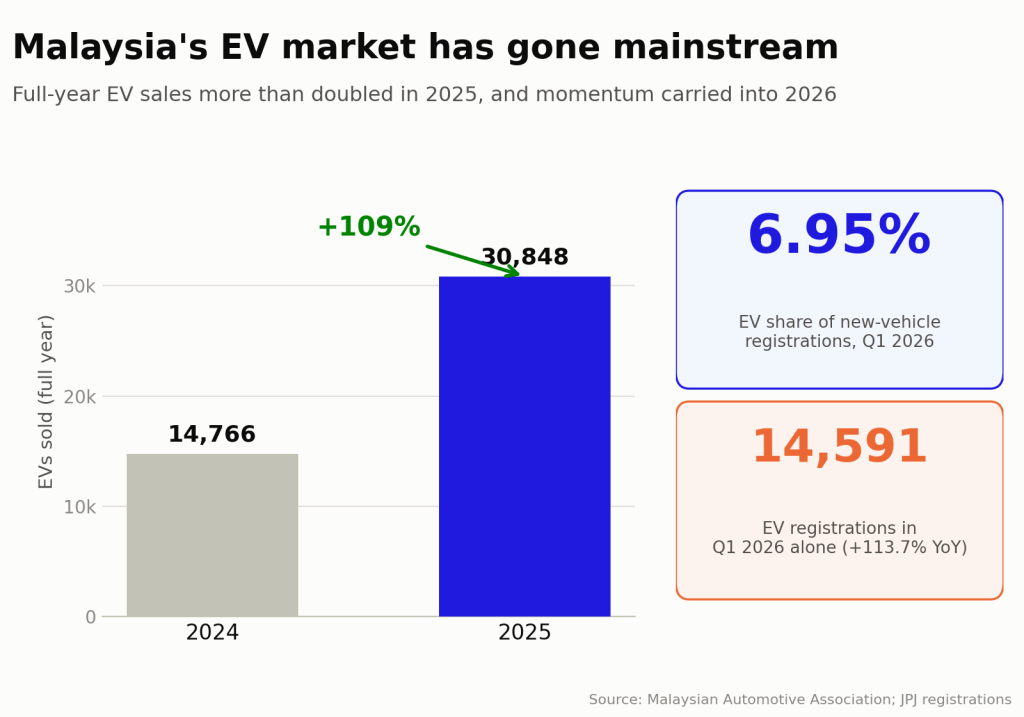
Full-year EV sales more than doubled in 2025; EVs now make up 6.95% of new registrations.
The single most important shift is who is winning. This is no longer a Tesla-and-BYD story. A national brand now takes roughly half of every EV registered in Malaysia.

Share of EV registrations by brand, March 2026.
| Brand | Share of EV registrations (Mar 2026) |
| Proton | ~50% |
| BYD | ~19% |
| Tesla | ~7% |
| Chery | ~6% |
| Zeekr | ~4% |
The Proton e.MAS 5, launched at an aggressive sub-RM60,000 price, single-handedly moved the market from “premium toy” to “reasonable second car.” Across Q1 2026, the e.MAS 5 alone accounted for 6,701 units.
Every EV brand and price in Malaysia (2026)
The Malaysian market now lists well over 90 EV variants. The tables below cover the mainstream and near-premium models most buyers actually shortlist. Prices are indicative on-the-road figures and are moving: CBU (fully imported) models are expected to rise as the post-exemption tax structure takes hold, while locally assembled (CKD) models stay protected until end-2027.

Where each model sits on price. CKD (local-assembly) models are shielded from the expired import-duty exemption.
Budget to mid-market (under RM130,000)
| Model | Price (RM) | Range | Assembly |
| Proton e.MAS 5 | 56,800 – 69,800 | 225 – 325 km | CKD |
| BYD Dolphin | 100,000 – 125,000 | 340 – 427 km | CBU |
| Proton e.MAS 7 | 99,800 – 119,800 | 410 – 460 km | CKD |
| GWM Ora Good Cat | 109,800 – 119,800 | 400 – 500 km | CBU |
| Neta X | 119,888 – 135,888 | ~480 km | CBU |
| Chery Omoda E5 / iCaur V23 | ~118,000 – 130,000 | 400 – 430 km | CBU |
| MG 4 EV | 104,000 – 159,000 | 350 – 520 km | CBU |
Mid to premium (RM130,000 – RM300,000)
| Model | Price (RM) | Range | Assembly |
| BYD Atto 3 | 123,800 – 149,800 | 410 – 480 km | CBU |
| BYD Seal | 171,800 – 191,800 | 460 – 570 km | CBU |
| Tesla Model 3 | 169,000 – 189,000 | 513 – 629 km | CBU |
| Tesla Model Y | 195,500 – 288,000 | 466 – 600 km | CBU |
| Zeekr X / 7X | ~190,000 – 260,000 | 440 – 600 km | CBU |
| Xpeng G6 | ~165,000 – 200,000 | 550 – 750 km | CKD* |
| Hyundai Ioniq 5 | 199,888 – 259,888 | 450 – 630 km | CBU |
*CKD (local assembly) planned. The price cliff sits around RM100,000. Below it, Proton has effectively no direct rival on value. Between RM100k–200k is the most crowded, most competitive bracket, and this is where the 2026 price war is being fought, where Chinese CKD entrants (Zeekr, Xpeng, MG, Leapmotor) will apply the most downward pressure once local assembly ramps up.
Incentives: what you still get in 2026 (and what expired)
What expired at the end of 2025
CBU import & excise duty exemption ended 31 December 2025. Fully imported EVs qualified only if stock physically entered Malaysia and was declared to customs before the cutoff (the industry worked to a 28 December 2025 arrival date). Analysts expect CBU prices to rise by at least 30% as this washes through, though fierce competition is currently absorbing much of it.
100% road tax exemption ended 31 December 2025. From 1 January 2026, EVs pay road tax under a new kW-based structure, but it remains roughly 85% cheaper than an equivalent petrol car.
| Model (motor output) | New EV road tax (per year) |
| Proton e.MAS 5 (~58 kW) | ~RM20 – 30 |
| BYD Atto 3 (~150 kW) | ~RM160 |
| Tesla Model Y RWD (~220 kW) | ~RM305 |
What still applies in 2026
CKD (locally assembled) EV tax exemption runs until 31 December 2027. This is the government’s central lever now. It is exactly why Proton e.MAS is so cheap and why Zeekr, Xpeng, MG, BYD and Leapmotor are racing to assemble locally. The takeaway for buyers: CKD models offer the most price stability through 2027; CBU models carry price risk.
RM2,500 income tax relief for home charger installation is available until Year of Assessment 2027. Install a home wallbox and claim up to RM2,500 in personal income tax relief. Keep the receipt.
The charging reality: does the network support ownership?
The government targeted 10,000 public chargers by end-2025. It missed, badly. As of end-November 2025, Malaysia had 5,360 licensed public EV chargers.
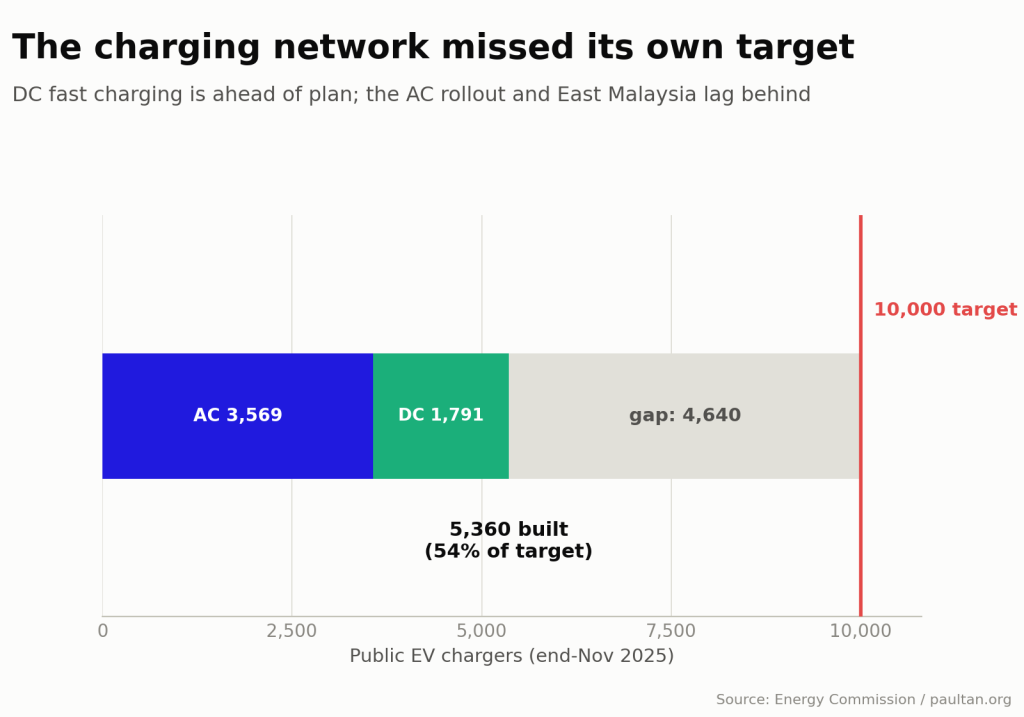
Malaysia hit just 54% of its 10,000-charger target; DC fast charging leads, AC lags.
- DC fast charging is the bright spot: the rapid-charger rollout has outpaced its own target, which matters far more for long-distance travel than the AC shortfall.
- The AC shortfall reflects behaviour, not just failure: most owners charge at home overnight, so demand for slower public AC chargers has been soft.
- The real gaps are geographic: the 5,360 figure is essentially Peninsular Malaysia. Sabah and Sarawak remain badly underserved.
- Home charging is the backbone. Landed-home owners are well served; high-rise condo dwellers face the network’s weakest link.
Verdict: for a Klang Valley or Peninsular commuter with home charging, the 2026 network comfortably supports daily ownership and most intercity travel. For East Malaysia, or anyone wholly dependent on public charging, the network is still maturing.
So should you buy an EV in Malaysia in 2026?
Buy now if you have home charging, drive mostly within Peninsular Malaysia, and want a CKD model (Proton e.MAS above all) whose price is protected through 2027.
Wait or think harder if you’re eyeing a fully imported (CBU) model (prices are in flux post-exemption), or if you live in East Malaysia or a high-rise without charging access.
The market direction is unambiguous: more local assembly, more Chinese competition, falling prices in the RM100k–200k band, and an intensifying price war through 2027. Buyers gain; the pressure is on margins, not demand.
Frequently asked questions
How many EVs were sold in Malaysia in 2025?
30,848 fully electric vehicles, a 109% increase over 2024. Including hybrids, 69,363 electrified vehicles were registered.
What is the cheapest EV in Malaysia in 2026?
The Proton e.MAS 5, starting around RM56,800, which is also the best-selling EV in the country.
What is the best-selling EV in Malaysia?
The Proton e.MAS 5. In March 2026 it recorded 2,071 registrations, and Proton took roughly 50% of all EV registrations.
Did Malaysia’s EV tax exemption end?
The CBU (fully imported) import and excise duty exemption ended on 31 December 2025. The CKD (locally assembled) exemption continues until 31 December 2027.
Do EVs still pay road tax in Malaysia?
Yes, from 1 January 2026, under a kW-based structure roughly 85% cheaper than an equivalent petrol car, from about RM20 a year for a Proton e.MAS 5 to around RM305 for a Tesla Model Y.
Is there tax relief for installing a home EV charger?
Yes, up to RM2,500 in personal income tax relief, available until Year of Assessment 2027.
How many public EV chargers does Malaysia have?
About 5,360 as of end-November 2025 (3,569 AC and 1,791 DC), short of the 10,000 target. DC fast chargers have exceeded their target; AC rollout lags.
Will EV prices go up or down in 2026–2027?
Mixed. CBU (imported) prices face upward pressure after the exemption expired, but competition and local assembly are pushing mid-market prices down. Net effect through 2027: more choice and a price war in the RM100k–200k segment.
Sources
• MAA: 30,848 new EVs sold in 2025 (paultan.org)
• EV Registrations March 2026 (SoyaCincau)
• Malaysia has 5,360 public EV chargers as of end-Nov (paultan.org)
• CBU EV tax exemptions cutoff (Lowyat.NET)
• CKD EVs tax-exempt until Dec 31, 2027 / Budget 2023 (paultan.org)
• Malaysia EV Guide 2026: prices, road tax, relief (malaysia4u.com)
• Electric car price list 2026 (Zigwheels)