

In three years, a Malaysian state next door to Singapore became Southeast Asia’s fastest-growing hub for the infrastructure behind AI. Then its own power grid forced a rethink.
In short: Johor has gone from a near-standing start to more than 1,500 MW of live data center capacity and a pipeline approaching 5.8 GW, drawing an estimated RM165 billion (about US$42 billion) in investment, according to Wood Mackenzie. The pull is cheap land and power beside Singapore, the region’s digital capital. The constraint, now official policy, is electricity and water: in February 2026 Malaysia froze approvals for new non-AI data centers.
Why is Johor becoming Southeast Asia’s data center capital?
Four forces are stacked on top of one another. The first is that Singapore ran out of room. From 2019 to 2022 the city-state effectively halted new data center construction to manage its land, power and carbon limits. That pause redirected hyperscaler expansion plans to the nearest viable location: Johor, a 40-minute drive across the causeway. Even after Singapore reopened under strict sustainability rules, Johor kept the momentum, because the underlying math never changed.
The second is proximity to demand. Operators can serve Singapore’s dense financial and enterprise market from Johor while sidestepping the city-state’s cost and capacity ceilings. The area is also unusually well-connected, with more than 20 international submarine cables landing nearby. The third is land, power and cost: Malaysia is more than 450 times larger than Singapore, electricity averages around US$0.10 per kWh, and construction costs are among Southeast Asia’s lowest. In a business where power is the single biggest operating expense, that is decisive.
The fourth is policy. The Johor-Singapore Special Economic Zone, launched in January 2025, streamlines cross-border trade, immigration and customs. Malaysia layers on incentives: Malaysia Digital Status, the Digital Ecosystem Acceleration Scheme, and a “Green Lane” that cuts grid-connection times from 36 to 48 months down to roughly 12.
Johor didn’t win on strategy alone. It won on adjacency, capturing spillover demand from a world-class neighbour, which also means its ceiling is partly set by forces it doesn’t control.
Who is building data centers in Johor?
The tenant list spans US and Chinese hyperscalers, pan-Asian colocation operators, and Malaysian conglomerates. Microsoft, Oracle and Google anchor the cloud names; ByteDance is a major tenant; and YTL, in partnership with NVIDIA, is building a “green” campus tied to Malaysia’s first sovereign large language model.
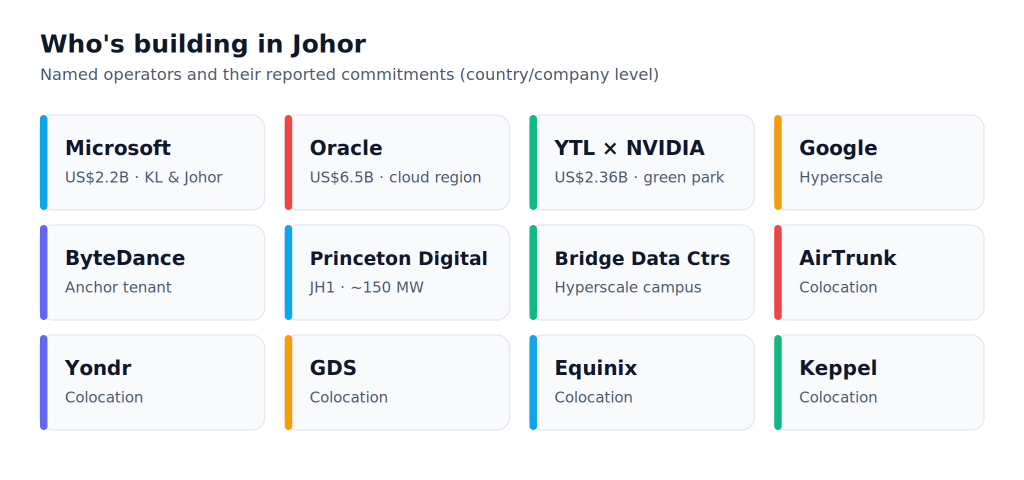
Selected operators active in Johor. Figures are company/country-level commitments and may span sites beyond Johor. Sources: Introl, kr-asia, Malay Mail, The Edge, DCD.
How big is the boom, really?
The scale is easiest to grasp against Singapore. Johor’s Menteri Besar has noted that Singapore took about 15 years to build more than 70 data centers totalling roughly 1.4 GW, while Johor attracted more than 50 data centers in about two years. Capacity climbed from around 10 MW in 2022 to over 1,500 MW live today, with projections near 3,600 MW by 2027 and an announced pipeline of 5.7 to 5.8 GW, potentially 60% of Malaysia’s total capacity by 2030.
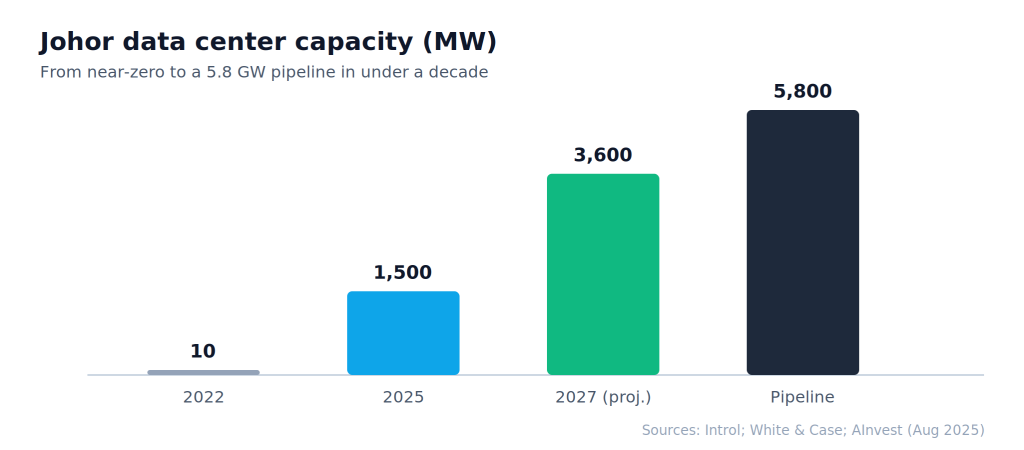
Capacity is reported inconsistently: live operational load (~1.5 GW) versus announced pipeline (5+ GW). Both are true; they measure different stages.
Investment tracks the same curve: roughly US$42 billion cumulatively, per Wood Mackenzie, which also finds Johor accounts for around 51% of Peninsular Malaysia’s data center maximum demand. Malaysia as a whole holds more than half of Southeast Asia’s under-construction capacity, and Johor’s electricity load for data centers more than doubled between 2024 and 2025.
Where in Johor are they being built?
The boom is geographically concentrated, mostly in the Kulai district within Iskandar Malaysia. Sedenak Tech Park is the epicenter, with Nusajaya Tech Park and YTL’s green campus close behind.

Schematic, not to scale. Johor’s clusters sit within Iskandar Malaysia, close to Singapore’s demand and subsea cable landings.
The other side: power, water, and the 2026 freeze
The boom’s biggest risk isn’t demand, it’s resources. On 24 February 2026, Prime Minister Anwar Ibrahim confirmed that Malaysia has, for close to two years, limited approvals for new data centers that are not AI-related, citing electricity and water pressure. Facilities offering genuine AI benefit still get approved; commodity storage does not. Anwar said current capacity is sufficient “for the next one or two years,” with future supply eyed from the ASEAN Power Grid and Sarawak’s hydro and solar.
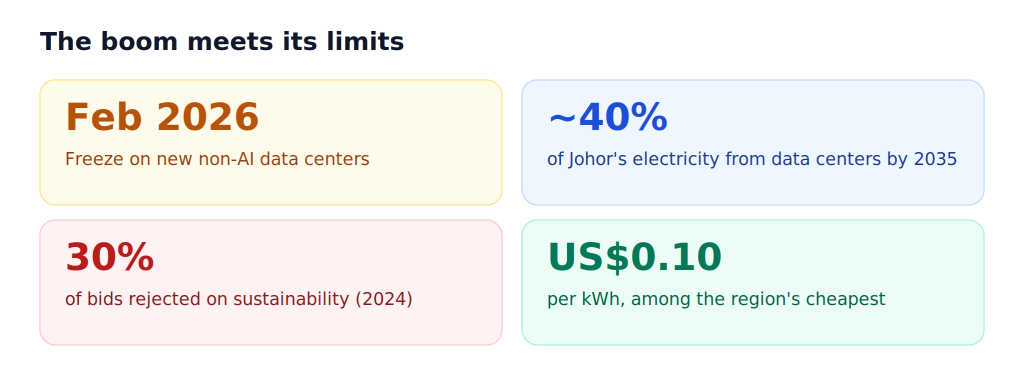
Sources: Malay Mail (Feb 2026 freeze; 2024 rejections); Wood Mackenzie (2035 projection); White & Case (electricity cost).
Water is the sharper squeeze. Johor has tightened water-use rules, pushed operators toward reclaimed water (new treatment plants are being built, with an early phase due around June 2027), and in some cases rejected liquid-cooling applications outright. In November 2024, the state reported turning away about 30% of data center bids for failing sustainability goals. On power, Wood Mackenzie projects data centers could draw close to 40% of Johor’s electricity by 2035, even as roughly 2.1 GW of coal capacity retires in the mid-2030s. Operators had signed 1.3 GW of renewable-supply agreements by mid-2025 to keep the growth green. Add US restrictions on advanced AI chips, the risk of over-building, and a construction-labor shortage, and the picture is a boom being actively managed rather than left to run.
What it means for Malaysia and the region
Johor has done something few emerging markets manage: it turned geographic luck into a real industrial cluster, complete with supply chains, and put Malaysia at the center of Southeast Asia’s AI infrastructure map. The open question is whether the boom becomes a durable industry or a cautionary tale of resource strain. The February 2026 freeze is the pivot: Malaysia is now explicitly trading volume for value, favoring AI workloads that justify the power and water they consume over commodity storage that doesn’t. For brands, investors and operators, Johor is the clearest live case study in the region of a government trying to catch a once-in-a-generation infrastructure wave without draining its own grid.
Frequently asked questions
Where is Johor’s data center hub located?
Mostly in the Kulai district (especially Sedenak Tech Park and Nusajaya Tech Park), within the Iskandar Malaysia zone, close to the Singapore border.
Why are data centers moving from Singapore to Johor?
Singapore paused new data center construction from 2019 to 2022 over land, power and carbon limits. Johor offered cheap land and electricity next door, keeping the demand even after Singapore reopened.
Who are the biggest data center companies in Johor?
Named players include Microsoft, Oracle, Google, ByteDance, YTL (with NVIDIA), Princeton Digital Group, Bridge Data Centres, AirTrunk, Yondr, GDS, Equinix and Keppel.
Did Malaysia stop approving new data centers?
In February 2026 it froze approvals for new non-AI data centers over power and water concerns. AI-focused facilities are still approved.
Sources
- Wood Mackenzie: JB data center expansion: https://www.woodmac.com/press-releases/jb-data-center-expansion/
- White & Case: What is propelling Malaysia’s data centre boom?: https://www.whitecase.com/insight-our-thinking/what-propelling-malaysias-data-centre-boom
- kr-asia: Malaysia’s data center boom: an inside look: https://kr-asia.com/malaysias-data-center-boom-an-inside-look-at-asias-battle-for-ai-supremacy
- Introl: Malaysia $15B AI investment: Johor tech hub: https://introl.com/blog/malaysia-ai-infrastructure-15-billion-investments
- Malay Mail: Johor draws over 50 data centres in two years: https://www.malaymail.com/news/malaysia/2024/07/05/johor-draws-over-50-data-centres-in-recent-two-year-period-says-mb/142782 (Jul 2024)
- Malay Mail: Johor snubbed 30pc of data centre bids: https://www.malaymail.com/news/malaysia/2024/11/20/official-johor-snubbed-30pc-of-data-centre-bids-for-not-meeting-sustainability-goals/157396 (Nov 2024)
- Malay Mail: Malaysia freezes new non-AI data centres: https://www.malaymail.com/news/malaysia/2026/02/24/malaysia-freezes-new-non-ai-data-centres-over-power-and-water-concerns-says-anwar/210287 (Feb 2026)
- AInvest: Johor to expand capacity to 5,800 MW: https://www.ainvest.com/news/johor-expand-data-center-capacity-5-800-megawatts-ai-driven-investments-2508/ (Aug 2025)
- The Diplomat: Whose water powers the cloud?: https://thediplomat.com/2026/04/whose-water-powers-the-cloud-data-centers-and-the-right-to-water-in-johor/ (Apr 2026)
- The Edge Singapore: Johor’s data centre boom, or bust?: https://www.theedgesingapore.com/news/data-centres/johors-data-centre-boom–or-bust