


Ask almost anyone in the global games industry to name the markets that matter and you will hear the same short list: the United States, China, Japan, maybe South Korea. Southeast Asia rarely comes up. Yet the region is home to roughly 290 million gamers and a games market worth $5.47 billion in 2025, according to Niko Partners. Only China and India are home to more gamers than Southeast Asia, yet the region barely registers in global industry conversations. The gap between how big Southeast Asia’s gaming economy actually is and how little attention it gets is one of the most striking blind spots in the industry today.
For brands, tourism boards, and platforms trying to reach young, digitally native Southeast Asians, that blind spot is an opportunity. Here is what the numbers actually say.
How big is the Southeast Asia gaming market?
Southeast Asia’s six largest markets (Indonesia, Malaysia, the Philippines, Singapore, Thailand, and Vietnam) generated $5.47 billion in player spending in 2025, up from $5.37 billion in 2024, according to Niko Partners. The market is projected to reach $6.47 billion by 2029, a compound annual growth rate of roughly 3.8%.
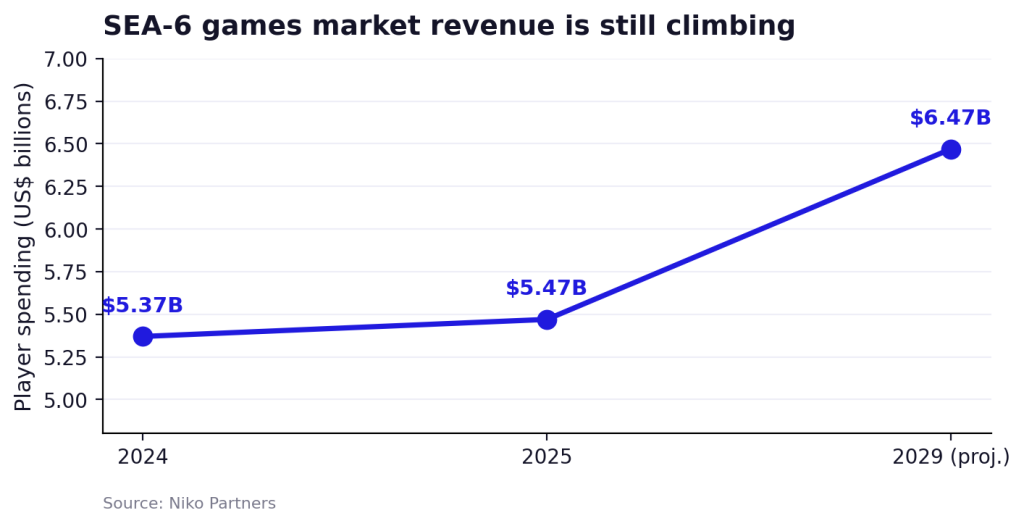
The player base is where the scale becomes obvious. The region counted around 290 million gamers in 2025 and is expected to grow to 324 million by 2029. Indonesia is the region’s largest market by player numbers, followed by the Philippines and Vietnam. Thailand, meanwhile, is the biggest and fastest-growing market by spending, projected to reach $2.4 billion by 2029
To put that in perspective: only two countries on earth, China and India, are home to more gamers than this single region, and the audience is still growing while spending patterns mature.
Why is Southeast Asia’s gaming market overlooked?
Three reasons explain the neglect.
First, revenue per user is lower than in Western markets. Average annual spend per player sat around $18.80 in 2024, a fraction of what a US or Japanese gamer spends. Global publishers chasing the highest immediate returns look elsewhere, mistaking low per-user spend for low opportunity.
Second, the market is mobile-first, not console-first. Mobile accounts for roughly 72% of gaming in the region, so the console-and-PC lens that dominates Western games media simply does not capture what is happening here.

Third, the region is fragmented: six major countries, multiple languages, different payment systems, and distinct regulatory regimes. That complexity scares off outsiders who prefer a single, homogeneous market. But fragmentation is exactly why local knowledge is a competitive advantage.
What do Southeast Asians actually play?
The region runs on mobile competitive titles. Garena Free Fire is the most-downloaded game across Southeast Asia, while Mobile Legends: Bang Bang leads on revenue and dominates markets like Malaysia. Tencent’s Honor of Kings has become one of the fastest-growing titles since its regional launch. These are free-to-play, socially driven, esports-ready games, not the premium single-player experiences that define much of Western coverage.

That competitive DNA runs deep. More than half of gamers in the six largest Southeast Asian markets are involved in esports, and Thailand has gone as far as officially recognizing esports as a sport, unlocking public investment and legitimacy. Livestreaming is mainstream too: around 52% of players watch game livestreams, turning gameplay into a spectator and community activity rather than a solitary hobby.
Why Southeast Asia matters for brands and advertisers
This is where the overlooked market becomes a commercial opportunity.

The audience is young, mobile-native, and highly social. More than 45% of players engage with in-game social features like chat and ranking, and the majority want localized content, with surveys showing around 87% of Southeast Asian gamers want some form of localization. Brands that show up in the local language, tied to local titles and events, earn trust that generic global campaigns never will.
The payment behavior points directly at partnership potential. Over 75% of the region’s gamers use digital wallets, making e-wallet providers, telcos, and fintech platforms natural partners for anyone trying to monetize or sponsor gaming content. Tourism boards and event organizers have an equally clear opening: esports tournaments draw massive live and online audiences across the region, and the infrastructure for large-scale gaming events is expanding fast.
For advertisers, the calculation is simple. You can compete for attention in saturated Western markets where every brand is already fighting, or you can build early authority in a region with 290 million engaged players, rising incomes, and comparatively little competition for their attention.
The window is open, but not forever
Southeast Asia’s gaming growth is maturing, not exploding. Average weekly playtime has actually declined, from roughly 21.8 hours in 2024 to about 15 hours in 2025, and regulation is tightening, with Vietnam now requiring game licenses. The era of effortless, hyper-growth is ending, which means the advantage is shifting to players who understand the region deeply rather than those who simply arrive early.
That is the real story global coverage misses. Southeast Asia is not overlooked because it is small or unimportant. It is overlooked because it is harder to understand than a single big number on a chart: mobile-first, multilingual, community-driven, and commercially distinct. The brands, platforms, and media that do the work to understand it now will own the relationships when the rest of the world finally notices.
SEA Exchange is building the definitive source for business, technology, and lifestyle intelligence across Southeast Asia. Beyond Borders.
Sources
Niko Partners, SEA of Opportunities: Exploring the Rise of Southeast Asia Video Games Market
Niko Partners, Asia & MENA Market Model 2025
Allcorrect, The Gaming Market in Southeast Asia
Charts and graphics: SEA Exchange original analysis based on the sources above.