

Google’s first Southeast Asia AI report and a new Malaysian study reveal a market racing into AI-native search, and a citation gap local businesses can’t afford to ignore.
Something quietly historic happened in Southeast Asia’s relationship with technology this year: the way hundreds of millions of people look for information changed. They stopped searching and started asking. Google’s first-ever Gemini Southeast Asia report, published this week, shows the region adopting AI faster than it has taken up any Google product in history, and doing it in its own languages, on its own phones, in its own voice. For Malaysian businesses, publishers and brands, the report is both a milestone and a warning. Because a second study, focused squarely on Malaysia, suggests that as audiences move into AI-powered answers, most local players are nowhere to be found in them.
Southeast Asia is going AI-native, fast
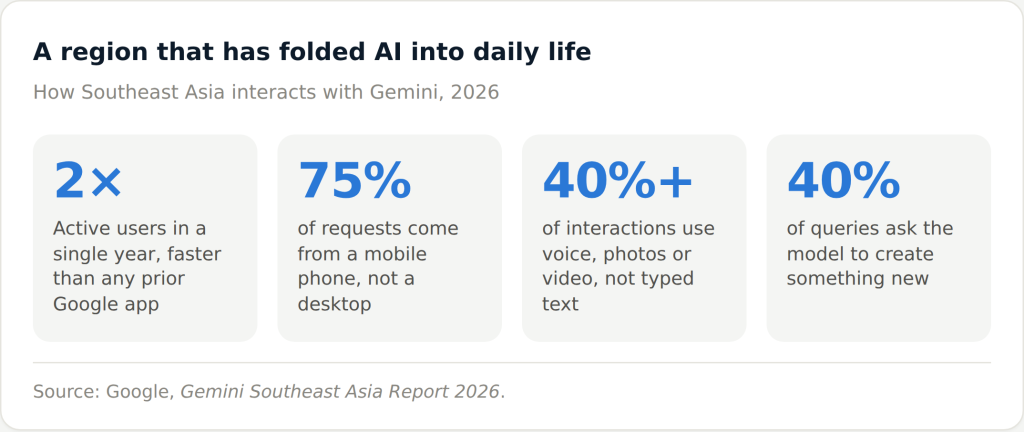
The headline from Google’s report is scale. Active Gemini users in the region more than doubled in a single year, growing faster than any previous Google app. But the more revealing numbers are about behaviour. Nearly 70% of prompts are written in native languages rather than English, led by Vietnam at 89%, Thailand at 87% and Indonesia at 84%. Three in four requests come from a mobile phone, not a desktop. And more than 40% of interactions now involve voice, photos or video rather than typed text, as tools like Gemini Live turn the camera and microphone into search inputs.

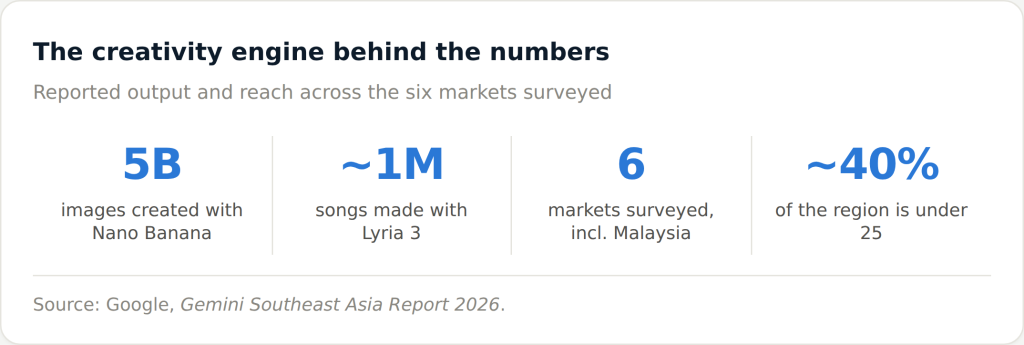
This is not a region cautiously experimenting with AI. It is a region that has folded AI into daily life. Roughly 40% of queries ask the model to create something new, whether a draft, an image or a plan, and the creative output is staggering: five billion images generated with Nano Banana and close to a million songs with Lyria 3. With nearly 40% of Southeast Asia’s population under 25, the behaviour skews young, and younger users hold longer, more detailed conversations than any other group.
The Malaysia-shaped hole in the data
Here is the catch for anyone building in Malaysia. Google surveyed six major markets (Indonesia, Malaysia, the Philippines, Singapore, Thailand and Vietnam), but the published report does not break out Malaysia’s numbers on their own. We know the country is inside the trend; we do not yet have a clean, authoritative picture of how Malaysians specifically prompt, in what language mix (English, Bahasa Melayu, Manglish, Mandarin, Tamil), and for which tasks.
That gap matters because Malaysia’s linguistic reality is unusually complex. A single user might ask a health question in English, negotiate a purchase in Bahasa, and switch to Manglish with a chatbot, often in the same afternoon. Any brand, hospital, hotel or media platform that wants to be the answer an AI gives needs to understand that mix. Right now, no one has cleanly documented it.
The ‘BM Blind Spot’ and the ‘Citation Gap’
A separate, Malaysia-focused study, the State of AI Search in Malaysia 2026, offers the first hard clues, and a caution. The researchers stress it is an early, directional sample of eight commercial queries, not a definitive survey; a larger 500-query study is planned. But the patterns are striking.
First, the language divide. The English query “personal loan malaysia” returned a full AI Overview, the generated answer box that increasingly sits above traditional results. Its exact Bahasa Melayu equivalent, “pinjaman peribadi malaysia,” returned no overview at all, just a map pack. The researchers call this the “BM Blind Spot”: for now, AI answers surface far more readily in English than in the national language, meaning Bahasa-first audiences may be served, and sold to, very differently.
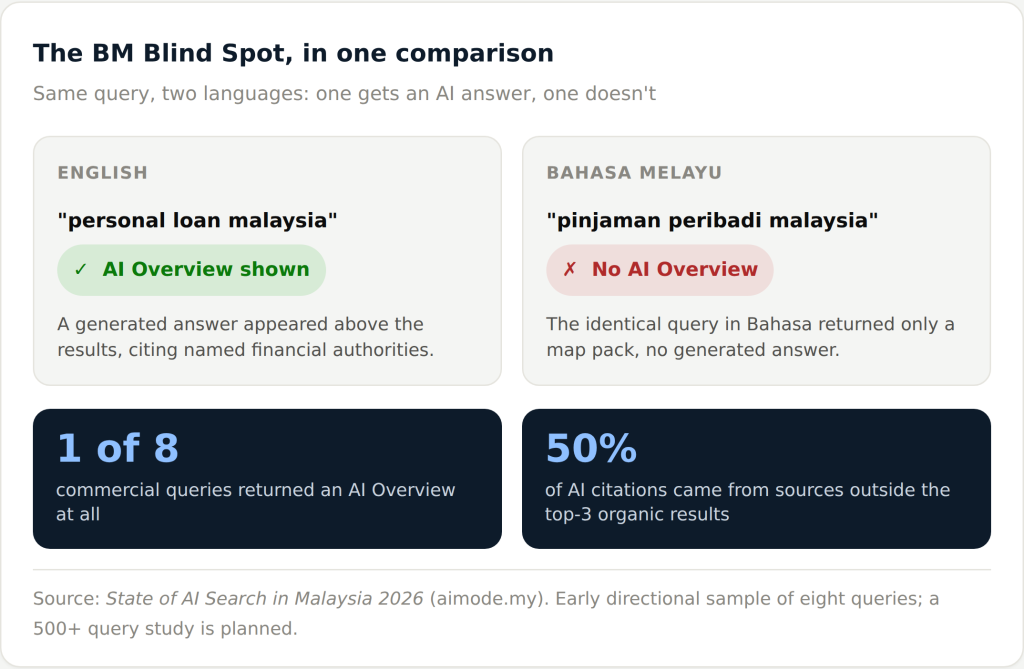
Second, the “Citation Gap.” When an AI Overview did appear, it cited recognised authorities: Maybank, CIMB, RinggitPlus and a RinggitPlus video. Crucially, half of those citations came from sources that did not rank in the top three organic results. In other words, being on page one of Google is no longer the finish line. AI engines choose whom to quote using their own logic, and a well-structured, authoritative page can leapfrog higher-ranked competitors straight into the answer itself.
What this means for Malaysian brands
Put the two studies together and the strategic picture is clear. Malaysian audiences are moving into AI-mediated discovery quickly, on mobile, and increasingly in their own languages, but the infrastructure of citations, sources and trusted answers is still being built. That is a rare thing in any market: an open field. The brands, publishers and institutions that document their expertise cleanly now, in both English and Bahasa Melayu, stand to become the default sources AI platforms quote for years. Those that wait will find the answer already written, with someone else’s name on it.
For organisations that want to show up in AI answers rather than watch from the sidelines, a few principles are already emerging:
- Publish in both languages. Mirror your key content in English and Bahasa Melayu so you are not invisible in half your own market.
- Answer real questions directly. Lead with the clear, quotable answer, then the detail. That is the format AI engines lift and cite.
- Be the primary source. Original data, first-hand figures and named expertise get quoted far more than recycled opinion.
- Structure everything. Clean headings, plain-language definitions, lists and FAQs make a page easy for a model to read and reuse.
- Build recognisable authority. Consistent, credible bylines and citations across the web signal trust, the currency AI systems reward.
The bottom line
Southeast Asia has become one of the world’s most enthusiastic adopters of AI, and Malaysia is squarely inside that wave. But the map of who gets cited, and in which language, is still being drawn. Google’s report tells us the audience has already moved. The Malaysian study tells us the answers are still up for grabs. For any brand serious about the next decade of visibility, the window to become a trusted source is open now, and it will not stay open long.
Sources: Google, Gemini Southeast Asia Report 2026 (blog.google); State of AI Search in Malaysia 2026 (aimode.my). Figures from the Malaysian study reflect an early directional sample and are described by its authors as indicative rather than definitive.