
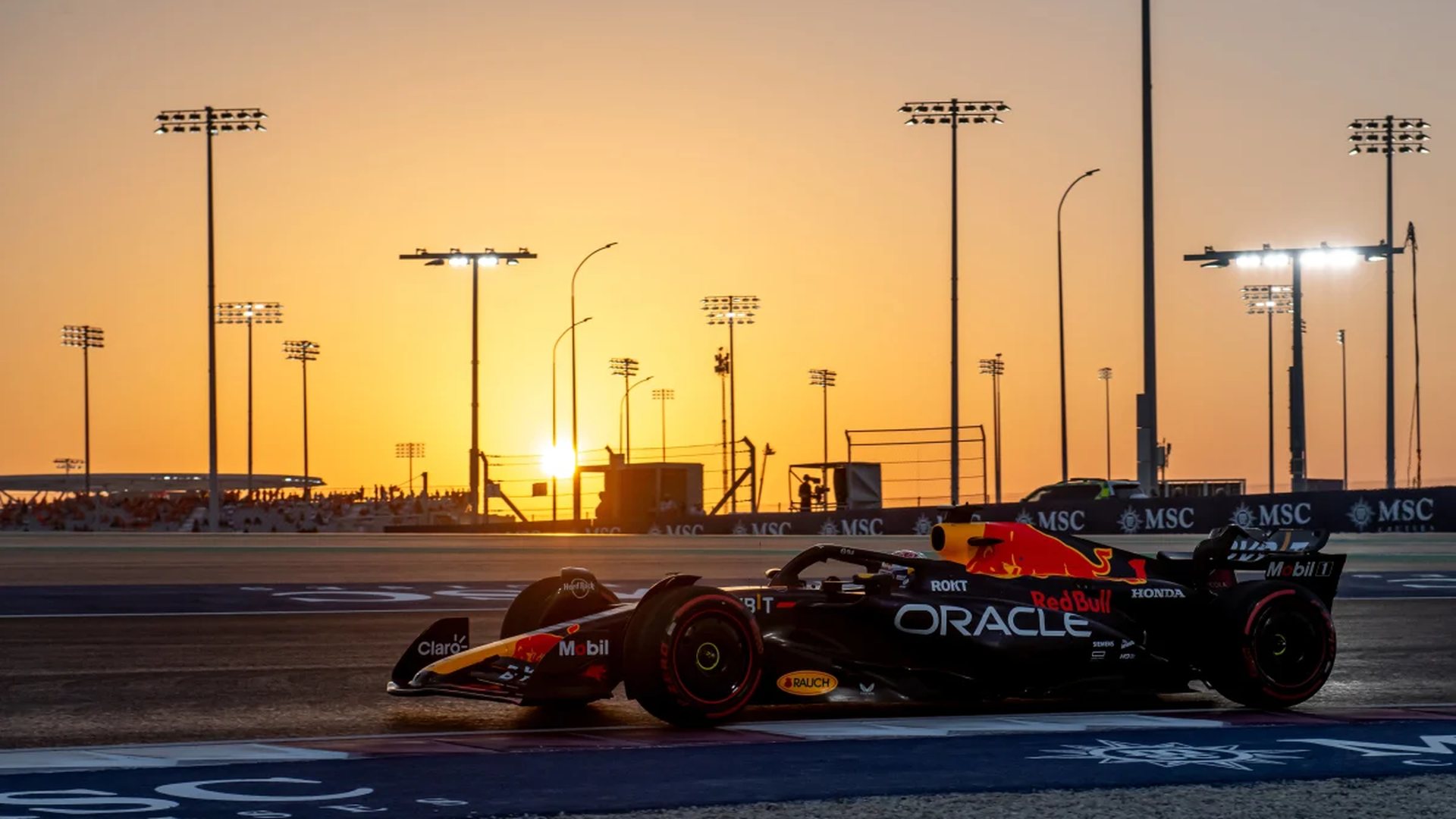
Nine years after the last Malaysian Grand Prix, Formula 1 races at Sepang again on 2 to 4 October 2026. It is not the Malaysian Grand Prix. Bahrain’s April round was postponed because of the conflict in West Asia, and on 26 July Formula 1 and the FIA confirmed that Sepang International Circuit would host it instead, under its original name, the Formula 1 Gulf Air Bahrain Grand Prix, with Bahrain paying the hosting fee. For Malaysia that makes it the cheapest Grand Prix the country has ever staged, and the first since 2017. Tickets went on sale on 15 August, from RM200 for Malaysians, and hotel rates near the circuit have already tripled.
In brief
- Race weekend: 2 to 4 October 2026 at Sepang, between Baku and Singapore in an Asian triple-header. Session times were not published by F1 as of late August; Sepang races have historically started around 3pm.
- Three-day tickets: RM200 (G Hillstand, MyKad only) to RM2,083 (Main Grandstand) for Malaysians; US$219 to US$566 for international fans. On sale at bahraingp.com.
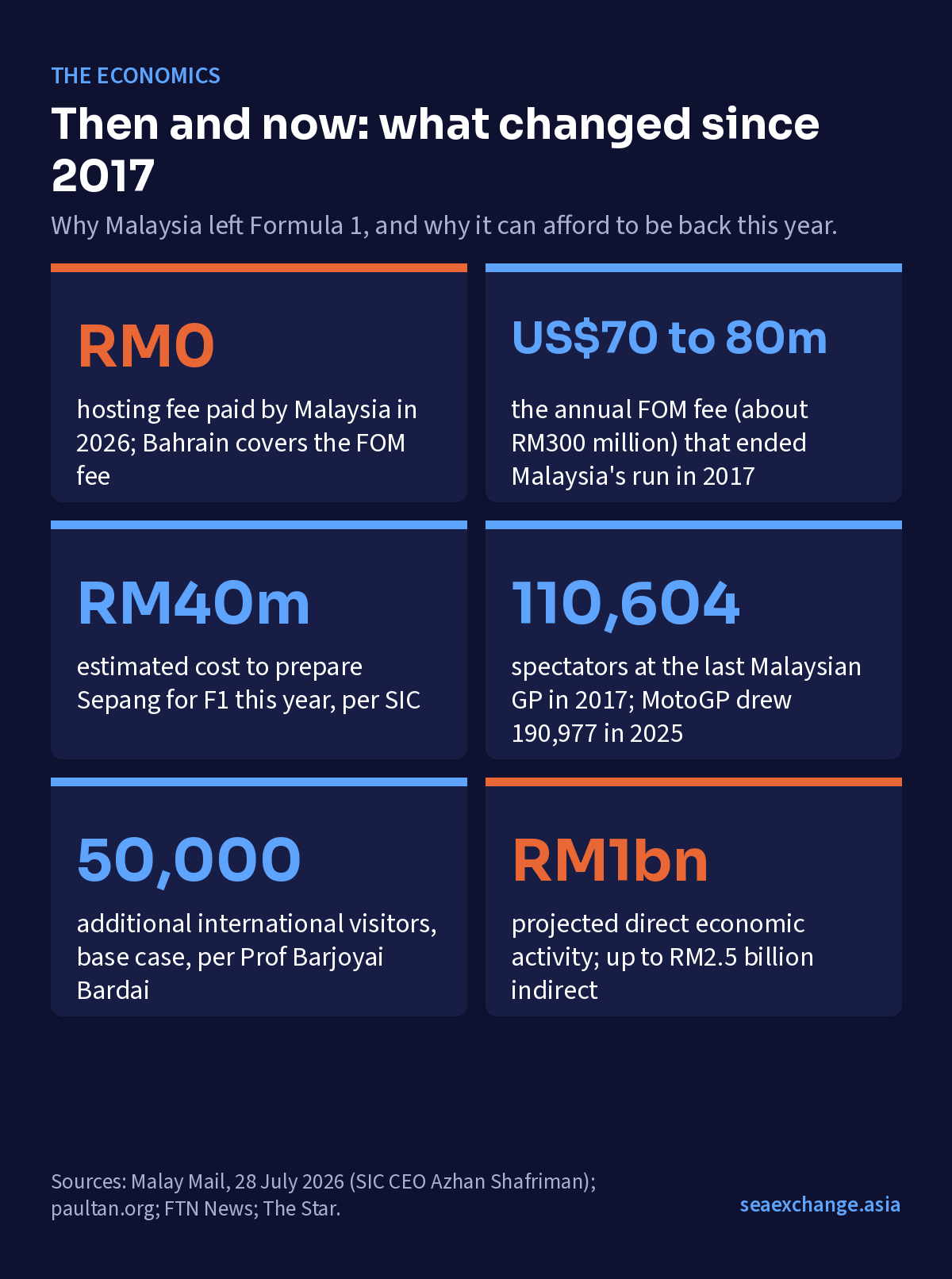
- Malaysia pays no hosting fee. Bahrain covers the FOM fee, which SIC puts at US$70 to 80 million; Malaysia’s outlay is about RM40 million to ready the circuit.
- Hotels near KLIA and Putrajaya have raised race-weekend rates by up to 246 per cent; budget listings were sold out by early August.
- Economists project about 50,000 additional international visitors and roughly RM1 billion in direct economic activity. A permanent return is possible but, on the government’s own numbers, unlikely.
Data as of 3 September 2026. Session times and transport arrangements will be updated when F1 and SIC publish them.
Why is a Bahrain Grand Prix being held in Malaysia?
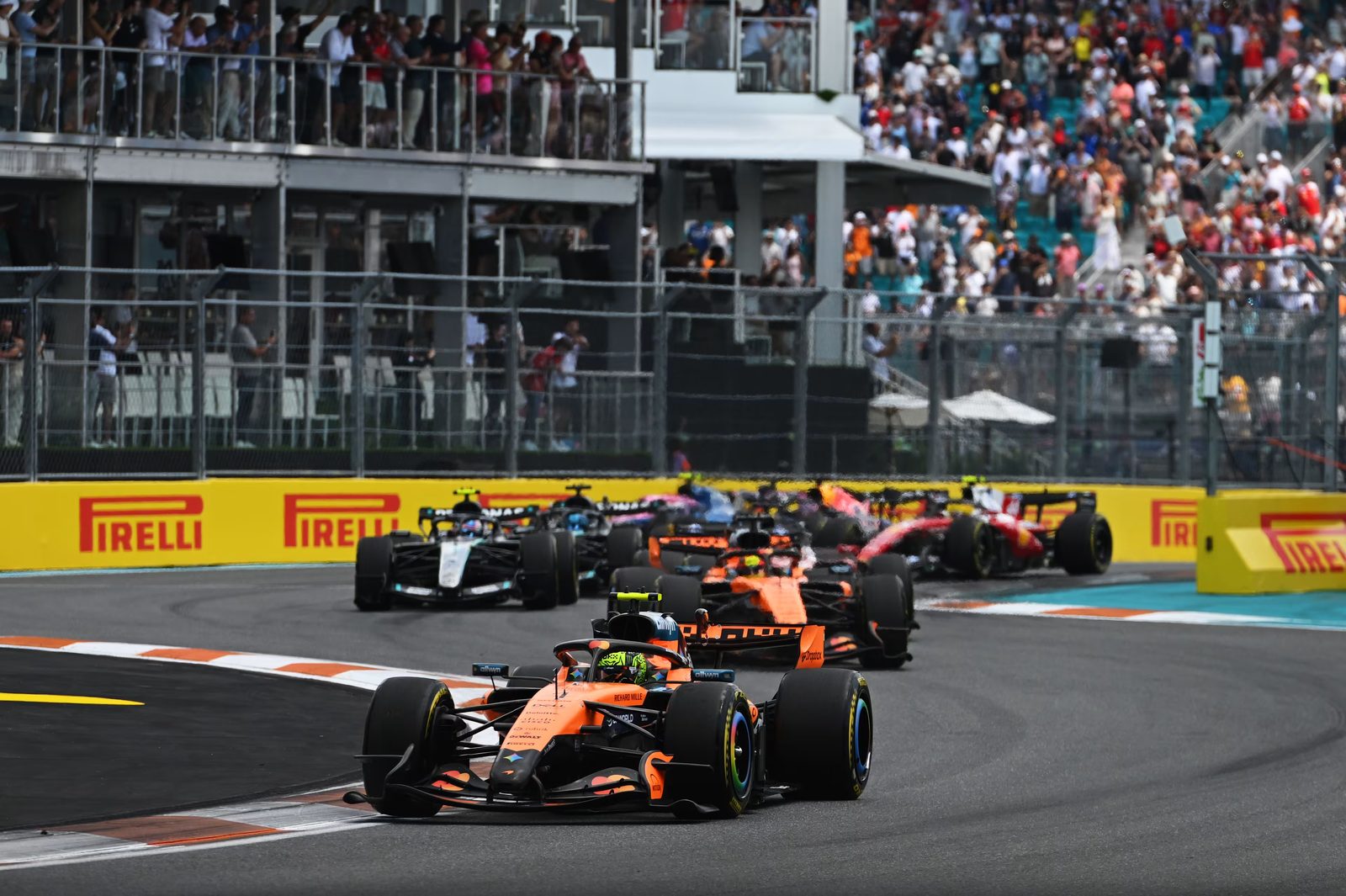
Formula 1’s Concorde Agreement commits it to a minimum of 21 races a season. When the Bahrain and Saudi Arabian rounds scheduled for April were postponed, F1 needed a replacement venue that could slot into the calendar without breaking the freight and travel logistics. Sepang sits between Baku (late September) and Singapore (mid October), is a Grade 1 circuit that F1 knows well, and, according to former SIC chief executive Razlan Razali, was the cheapest option on the table once Portugal’s Portimao was considered.
The deal is unusual. The race keeps the Bahrain name and its title sponsor, Gulf Air; Bahrain funds it “as a show of support for the sport”; and Malaysia’s financial commitment is limited to preparing the circuit. SIC chief executive Azhan Shafriman puts that at about RM40 million, on top of the RM16 million a year the government already spends keeping Sepang to international standard. Federal and Selangor governments have also allocated about RM17.5 million for road works on the approaches to the circuit.
What do tickets cost?
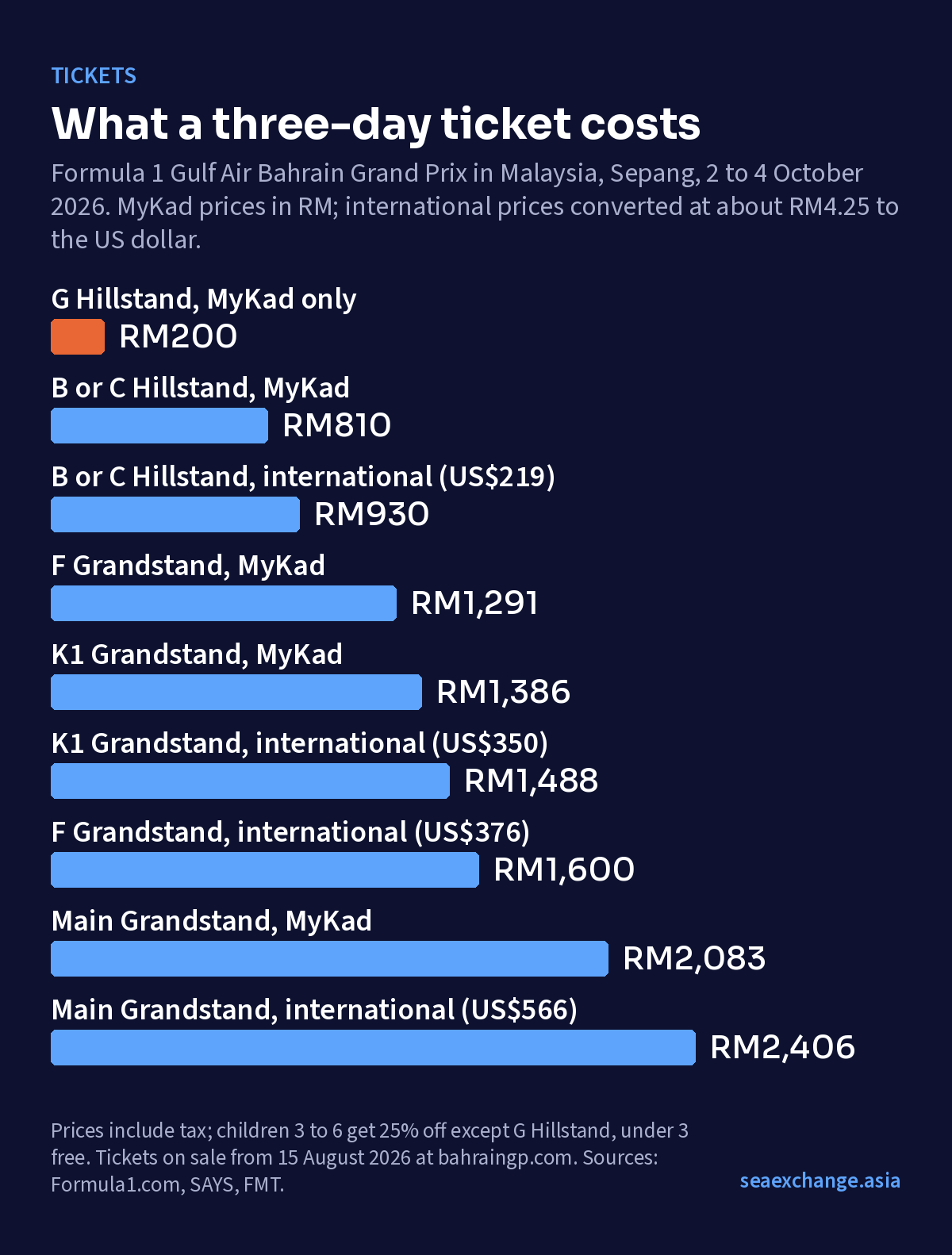
Tickets are three-day passes covering Friday practice, Saturday qualifying and the Sunday race, sold through Bahrain International Circuit’s site rather than SIC’s usual channels. Malaysian citizens get a separate MyKad price list, verified at purchase.
| Ticket | MyKad (RM) | International (US$) | What you get |
|---|---|---|---|
| G Hillstand | 200 | MyKad only | Grass hillstand; the cheapest way in, Malaysians only |
| B or C Hillstand | 809.60 | 218.90 | Open-air grass hillstands with a view of the pit straight or Turn 1 |
| F Grandstand | 1,291.40 | 376.39 | Covered, seated |
| K1 Grandstand | 1,386 | 350.13 | Covered, seated, final corners |
| Main Grandstand | 2,083.40 | 566.05 | Covered, seated, opposite the pits and podium |
All prices include tax. Children aged 3 to 6 get 25 per cent off (except G Hillstand) and under-3s enter free. Accessible seating is reserved by phone through Bahrain International Circuit. The MyKad price list is unusually generous by F1 standards: at RM200 for three days, the G Hillstand is cheaper than most Malaysian concert tickets this quarter.
What does a race weekend actually cost?
The ticket is the smaller part of the bill for anyone not living within driving distance. The table below is a realistic budget for one person on a three-day trip, using hotel rates listed on booking platforms in late July and early August.
| Item | Budget (RM) | Mid-range (RM) | Premium (RM) |
|---|---|---|---|
| Three-day ticket (MyKad) | 200 | 810 | 2,083 |
| Hotel, 3 nights | 390 (Coop or Monaco, Cyberjaya, about RM130 to 142) | 930 (Royal Park, Dengkil, RM309) | 14,490 (Movenpick KLIA suite, RM4,830) |
| Transport to circuit, 3 days | 90 (Grab from Cyberjaya or Salak Tinggi) | 150 (Grab from KLIA hotels) | 450 (private car and parking) |
| Food and drink, 3 days | 240 | 450 | 900 |
| Total | about RM920 | about RM2,340 | about RM17,900 |
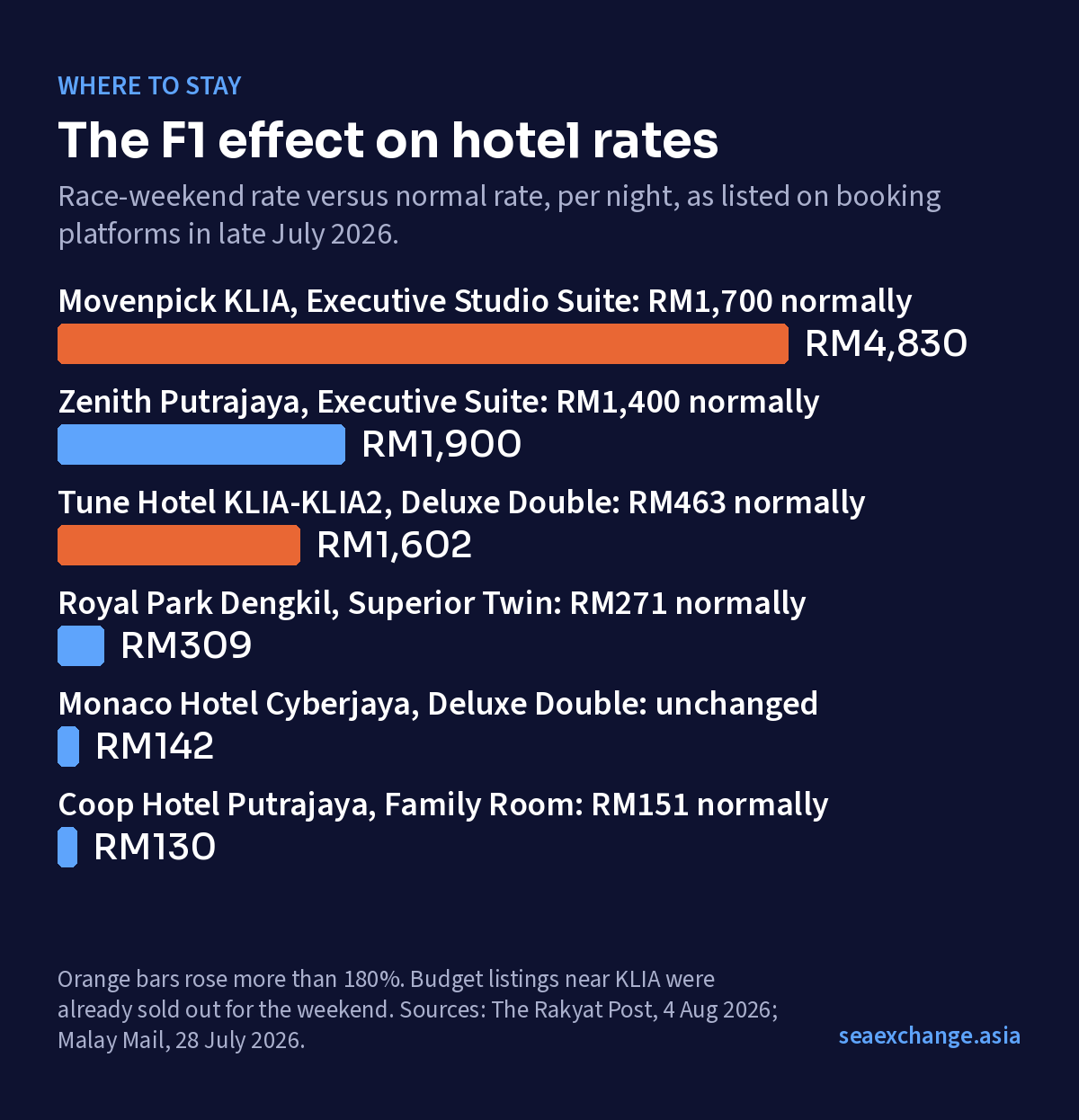
Two things distort the budget. First, the cheapest rooms are gone: by early August, budget listings at KLIA (Aha Horizon Suites, Arena Designer Suites) were sold out for the weekend on Booking.com. Second, the price gap between hotels a few kilometres apart is enormous. Tune Hotel KLIA-KLIA2 was listing a deluxe double at RM1,602, up 246 per cent from its normal RM463, while Monaco Hotel in Cyberjaya, 25 minutes away, was still RM142 and Coop Hotel Putrajaya had actually dropped to RM130.
Where to stay and how to get there
The circuit is 6 to 12 kilometres from KLIA, an 8 to 10 minute drive. KLIA hotels (Sama-Sama, Movenpick, Tune) are the most convenient and the most expensive. Putrajaya and Cyberjaya are 20 to 30 minutes away with far better value and plenty of supply. Kuala Lumpur city is 45 to 60 minutes by car outside race traffic and considerably more on Sunday afternoon.
By rail, the nearest station is Salak Tinggi on the KLIA Transit line, about 4 kilometres from the circuit, which is too far to walk on race day; a Grab or shuttle is needed for the last leg. SIC has not yet published its 2026 shuttle, parking or e-hailing arrangements. Driving is via the ELITE and KESAS highways; expect long queues into the circuit on Sunday and after the chequered flag.
Why did Malaysia leave Formula 1 in the first place?
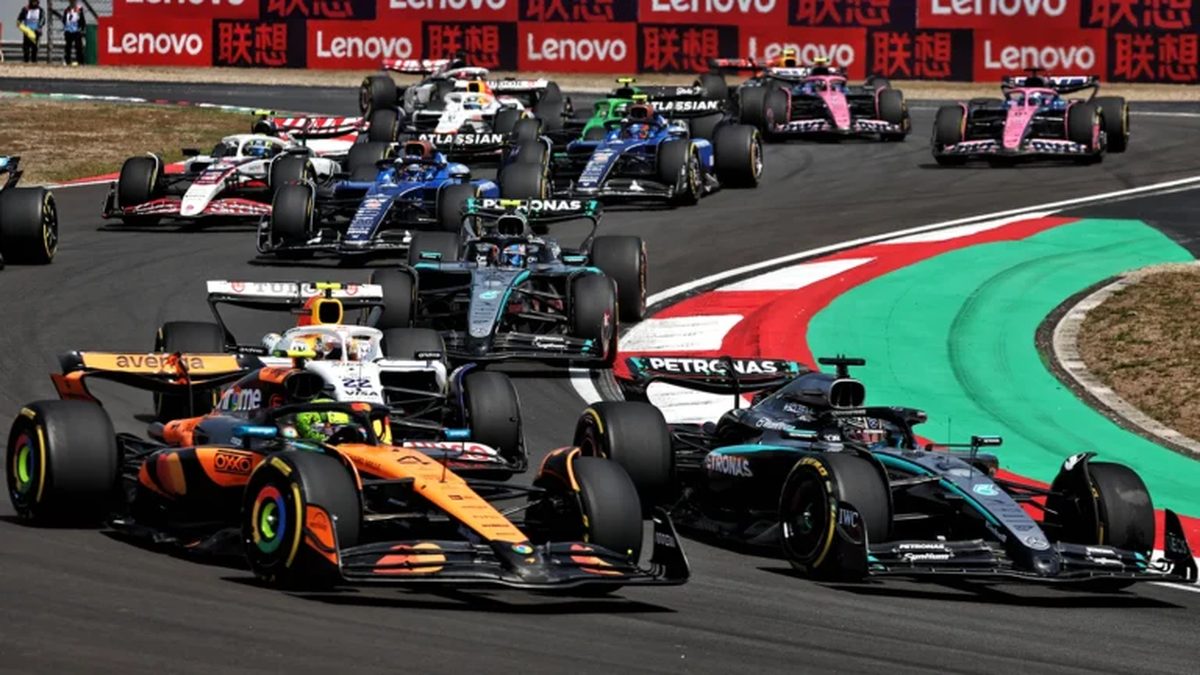
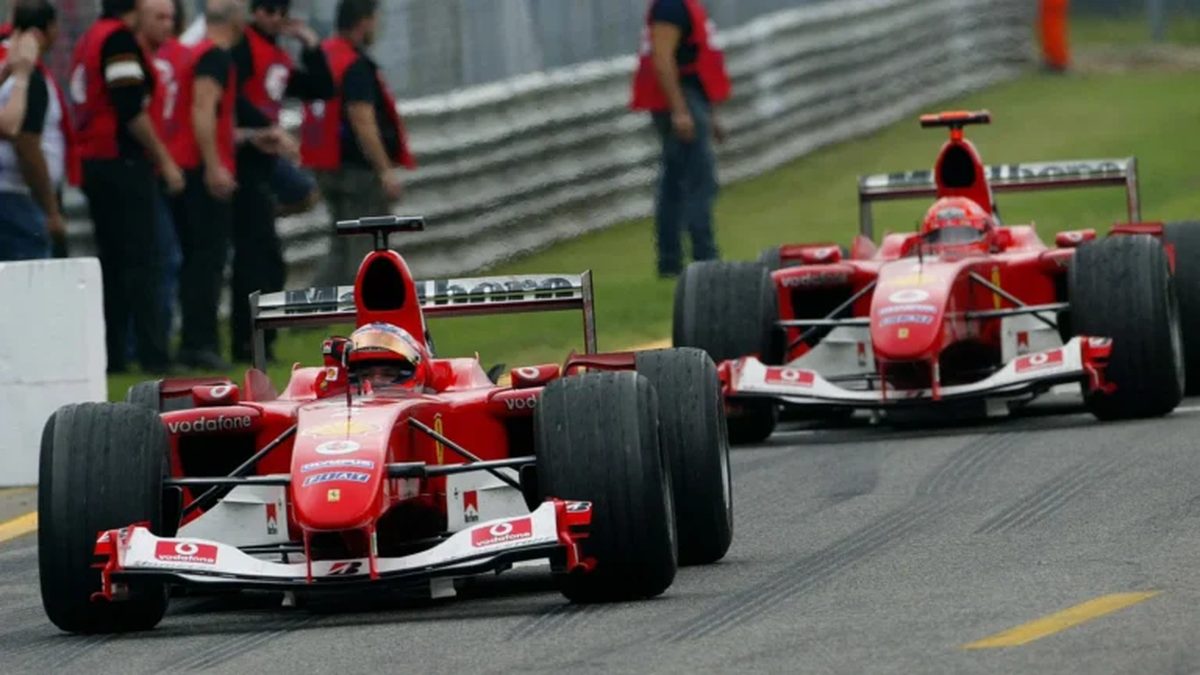
Malaysia hosted 19 Formula 1 Grands Prix between 1999 and 2017 at a circuit that was the first Hermann Tilke designed from scratch. The government ended the contract for economic reasons: the annual hosting fee had reached about RM300 million, ticket sales and television audiences were falling, and Singapore’s night race, launched in 2008, had taken the regional spotlight. The last race, on 1 October 2017, drew 110,604 spectators across the weekend, up from 88,828 in 2016, and was won by Max Verstappen the day after his 20th birthday.
Since then the calculus has only got harder. In 2024 officials said Liberty Media’s asking price was about US$70 million per race. As recently as August 2025, the government ruled out a return on cost grounds. That is why the 2026 race matters: it lets Malaysia run an F1 weekend, measure the spending and the crowd, and decide whether the number works, without paying the fee.
What is it worth to Malaysia?
Estimates so far are projections, not measurements. Professor Emeritus Dr Barjoyai Bardai’s base case is about 50,000 additional international visitors, roughly 90,000 extra passenger movements through KLIA, and about RM1 billion in direct economic activity, with an indirect effect of up to RM2.5 billion. Malaysian Association of Hotels and industry groups have reported a surge in bookings since the July announcement. Two cautions from people who have run the circuit: Razlan Razali notes that F1 fans usually plan trips six months ahead, so the ten-week lead time will cap overseas attendance, and Tan Sri Mokhzani Mahathir, president of the Motorsports Association of Malaysia, says about 30 per cent of Sepang’s F1 and MotoGP crowds are typically foreign.
The comparison that matters is the MotoGP, four weeks later on 30 October to 1 November. It set an all-time Sepang record of 190,977 spectators in 2025 and Malaysia has just extended its contract to 2031. If the F1 weekend lands anywhere near that, at zero hosting fee, the case for a permanent return will be made in the gate receipts rather than in Parliament.
Will Formula 1 stay?
Officially, this is a one-off. Deputy Prime Minister Ahmad Zahid Hamidi has called it a “litmus test” for a comeback with government and corporate backing, and Prime Minister Anwar Ibrahim has framed it as a tourism and investment showcase. Razlan Razali, who ran SIC for a decade, puts the odds of a permanent slot as “quite slim” unless the Prime Minister pushes for it personally, because the hosting fee has not changed. The realistic path is the one Bahrain has just demonstrated: a partner willing to underwrite the fee, or a rotation arrangement with other Asian circuits. Either way, the decision will be shaped by three numbers from the first weekend of October: the crowd, the international share of it, and the hotel and airline revenue that follows.
The verdict
For fans, this is the best-value Formula 1 weekend in Asia: a RM200 three-day ticket, a circuit ten minutes from an international airport, and a MotoGP a month later if one race is not enough. Book accommodation in Putrajaya or Cyberjaya rather than at KLIA, and treat Sunday transport as the hard part. For Malaysia, it is a free trial of a product it decided in 2017 it could not afford. Whether the trial converts depends less on the racing than on what the gate and the hotels report on 5 October.
Related reading on SEA Exchange
- Malaysia Events Calendar, October 2026 to December 2027
- Inside Malaysia’s MICE Boom: The Venues, Organisers and Numbers Behind 2026
- Who’s Actually Visiting Malaysia in 2026, and Why It’s an ASEAN Story, Not a Global One
Sources
- Formula1.com, Malaysia confirmed as host venue for the Bahrain Grand Prix (26 July 2026); ticket launch (August 2026)
- Sky Sports
- SAYS, official ticket prices; FMT
- Malay Mail, how Malaysia is hosting F1 without paying the fees (28 July 2026)
- The Rakyat Post, hotel prices (4 August 2026); Malay Mail, the F1 effect
- paultan.org, permanent return unlikely; 10 facts about the 2017 race
- The Star, economic upside; FTN News, US$250 million estimate; SoyaCincau
- Wego, session times and transport; MotoGP.com