


Generative tools are already inside the games you play, and the fight over whether players deserve to know is reshaping the world’s largest entertainment industry.

For an industry that dwarfs film and music combined, 2026 has been unusually quiet on new blockbusters and unusually loud on a single question: what happens when the machines start making the games? The video game business is passing through the sharpest technological reset since the shift to mobile, and this time the disruption is coming from inside the studio. Generative AI has moved from an experimental curiosity to a working part of the production pipeline, and the industry is discovering that the hard part was never the technology. It is the trust.
The disclosure war
The clearest evidence of how fast AI has spread is hiding on Steam, the PC platform that controls roughly three-quarters of digital game distribution. Since Valve began requiring developers to disclose generative-AI use in 2024, the numbers have climbed steeply: from around 1,000 games in the first year to roughly 8,000 by mid-2025. By 2026, at least one in five new releases carries an AI-disclosure label, and about 7% of Steam’s entire catalogue now discloses some form of generative AI in its creation. In under two years, AI went from novelty to a default part of how games get built.

Games disclosing generative-AI use on Steam surged roughly eightfold in 18 months.
That transparency has become a battleground. Epic Games chief executive Tim Sweeney called Valve’s disclosure requirement “really irresponsible,” arguing it brands developers with a “Scarlet Letter of AI” that invites pile-ons before a game is even judged on its merits. His argument is a commercial one: AI tools make small teams dramatically more productive, and forcing them to choose between using those tools or avoiding a stigmatising label puts them at a disadvantage against rivals who quietly do both. Transparency advocates counter that buyers deserve to know how a product was made. Both sides are really arguing about the same thing: whether “made with AI” is a warning or a feature.
It is already in the games you play
This is no longer hypothetical. Shipped, well-reviewed titles already lean on AI in ways most players never noticed. Arc Raiders used AI-assisted voice work; the acclaimed Clair Obscur: Expedition 33 used AI-generated placeholder textures during development. Neither made AI a selling point, and that is precisely the current state of play. Studios are using the tools but treating them as a liability to be disclosed rather than a capability to be marketed. Industry surveys suggest around 36% of developers now use AI in their workflow, which means the practice is already mainstream even as the messaging around it stays defensive.

Arc Raiders, which used AI-assisted voice work, shipped to strong reviews. Credit: Embark Studios.
The predicted tipping point is a major AAA release that puts AI-generated content, from environments to NPC dialogue to entire quests, front and centre as a reason to buy, and succeeds commercially. If that happens, backlash is guaranteed, but strong sales would send a blunt signal: that most players care more about the result than the method. That single outcome would reset the industry’s relationship with the technology overnight.
The human cost is already being paid
The uncomfortable subtext of the AI story is jobs. 2026 has been brutal for game workers: Microsoft alone cut around 3,200 roles and shed studios, and industry surveys indicate roughly one in three U.S. developers has been affected by layoffs over the past two years. Some cuts are being tied explicitly to AI. Mobile publisher Playtika opened the year by cutting about 500 people, roughly 15% of its workforce, while citing a shift toward AI-dependent resources. Whether AI is the true cause or a convenient narrative for cost-cutting during a lean release calendar, the perception that the technology is trading human craft for margin is hardening. That perception is exactly what fuels the disclosure backlash.
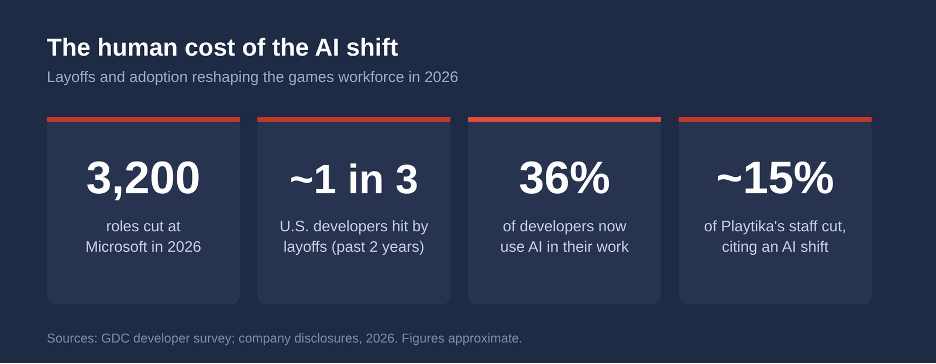
The workforce toll behind gaming’s AI transition in 2026.
Why this matters beyond gaming
Gaming is once again the leading indicator for where creative industries are heading. The disclosure debate, the productivity-versus-trust tension, the labour disruption: every media and content business will face the same questions within a few years, and gaming is field-testing the answers first. For Southeast Asia, one of the fastest-growing gaming markets on the planet and increasingly a production hub for global studios, the stakes are direct. Regional developers can use AI to punch far above their headcount and compete globally at lower cost, but they will do it under the same scrutiny, and the same disclosure expectations, as everyone else.
The winners in this cycle will not be the studios that use the most AI or the least. They will be the ones that figure out how to be transparent about it without being punished for it, turning “made with AI” from a scarlet letter into a mark of a smarter, faster, more ambitious kind of studio. That reframing is a branding problem as much as a technical one, and it is up for grabs right now.
Sources
Video Games Chronicle (Epic CEO on Steam AI disclosure); Steam AI disclosure data, 2024 to 2026; Luminate (Gaming Industry Off to a Shaky 2026); Tom’s Guide (2026 AI gaming predictions); GDC developer survey data.